
When people compare jewelry materials, one of the most common questions is: Which is harder — gold, silver, platinum, or moissanite?
The answer depends on what “hardness” actually means.In gemology and jewelry manufacturing, Mohs hardness measures a material’s resistance to scratching. It does not directly measure how easily a material bends, dents, cracks, or breaks.
This distinction matters. Gold, silver, and platinum are relatively soft metals compared with gemstones. Moissanite, by contrast, has a Mohs hardness of about 9.25, making it one of the hardest gemstones used in jewelry.
But a higher hardness number does not automatically mean a material is always more durable. Understanding the difference between hardness, toughness, and structural stability helps jewelry brands choose the right materials for each design.
1. What Is Mohs Hardness?
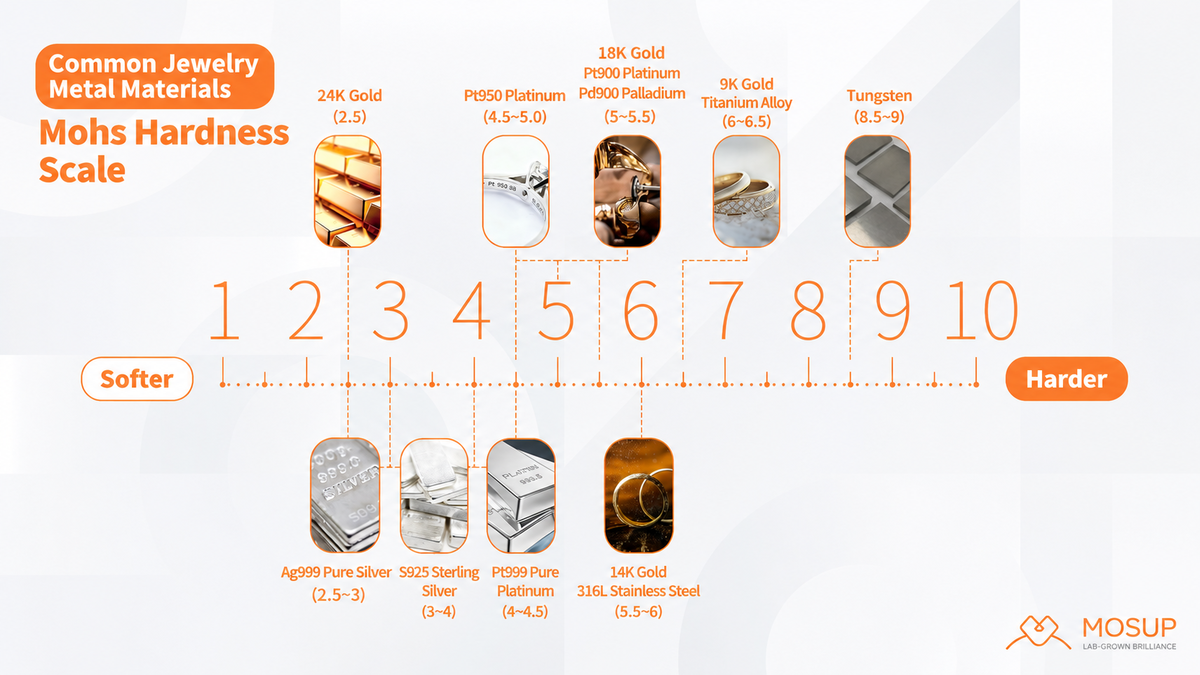
The Mohs scale is a relative mineral hardness scale from 1 to 10.
Its basic principle is simple:
A harder material can scratch a softer material. For example, moissanite can scratch gold, silver, and platinum because its surface hardness is much higher. However, the Mohs scale is not linear.
A material rated 9 is not simply three times harder than a material rated 3. The numbers indicate relative scratch resistance rather than equal mathematical intervals.
This is why jewelry professionals should avoid comparing Mohs values as simple percentages or multiples.
2. How Hard Are Gold, Silver, and Platinum?
Precious metals are relatively soft in their pure form. Their properties can change significantly when they are alloyed with other metals.
Typical jewelry hardness ranges include:
| Material | Approx. Mohs Hardness | Typical Jewelry Use |
| 24K Gold | 2.5–3 | High-purity gold jewelry, simple designs |
| Fine Silver | 2.5–2.7 | High-purity silver items |
| S925 Sterling Silver | 2.7–3 | Fashion jewelry and lighter gemstone settings |
| 14K Gold | 3–3.5 | Everyday jewelry and gemstone settings |
| 18K Gold | 3.5–4 | Fine jewelry and premium gemstone settings |
| Pt950 Platinum | approx. 4–4.5 | Fine jewelry and premium settings |
| Moissanite | approx. 9.25 | Center stones and gemstone jewelry |
Actual hardness can vary according to alloy composition, heat treatment, manufacturing method, and finishing process. For jewelry design, these values are best treated as practical reference ranges rather than fixed numbers.
3. Why Is 18K Gold Often Used for Gemstone Settings?
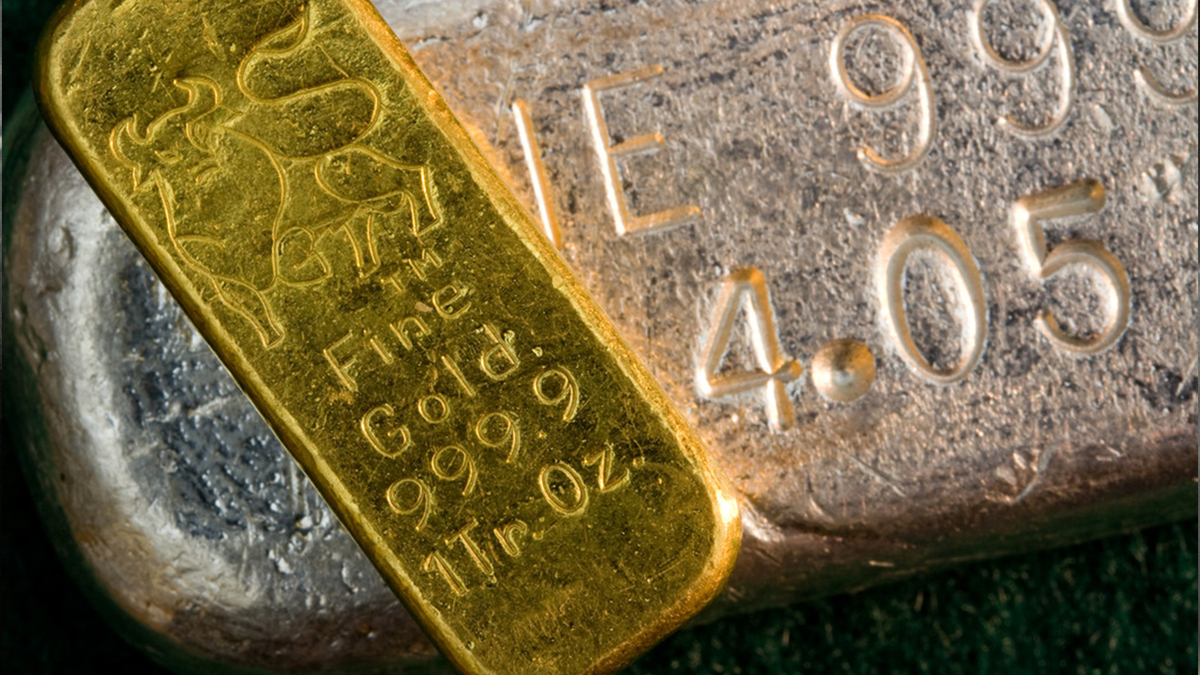
Pure gold is naturally soft and highly malleable. That makes it excellent for forming and shaping, but it also means 24K gold is more easily scratched or deformed during daily wear.
18K gold contains approximately 75% gold, with the remaining portion made up of alloying metals. These added metals change its mechanical properties.
The result is a material that still maintains the appearance and value associated with gold while offering better structural performance for jewelry manufacturing. This is one reason 18K gold is widely used for:
engagement rings, fine jewelry, gemstone settings, prong settings, and premium custom jewelry.
For a jewelry manufacturer, the important question is not simply:“Is the metal hard?”
A better question is: Can the metal maintain the required structure while securely holding the gemstone during long-term wear?
That involves more than hardness alone. Prong thickness, basket design, shank width, gemstone size, and overall construction all matter.
4. Is Sterling Silver Suitable for Gemstone Jewelry?
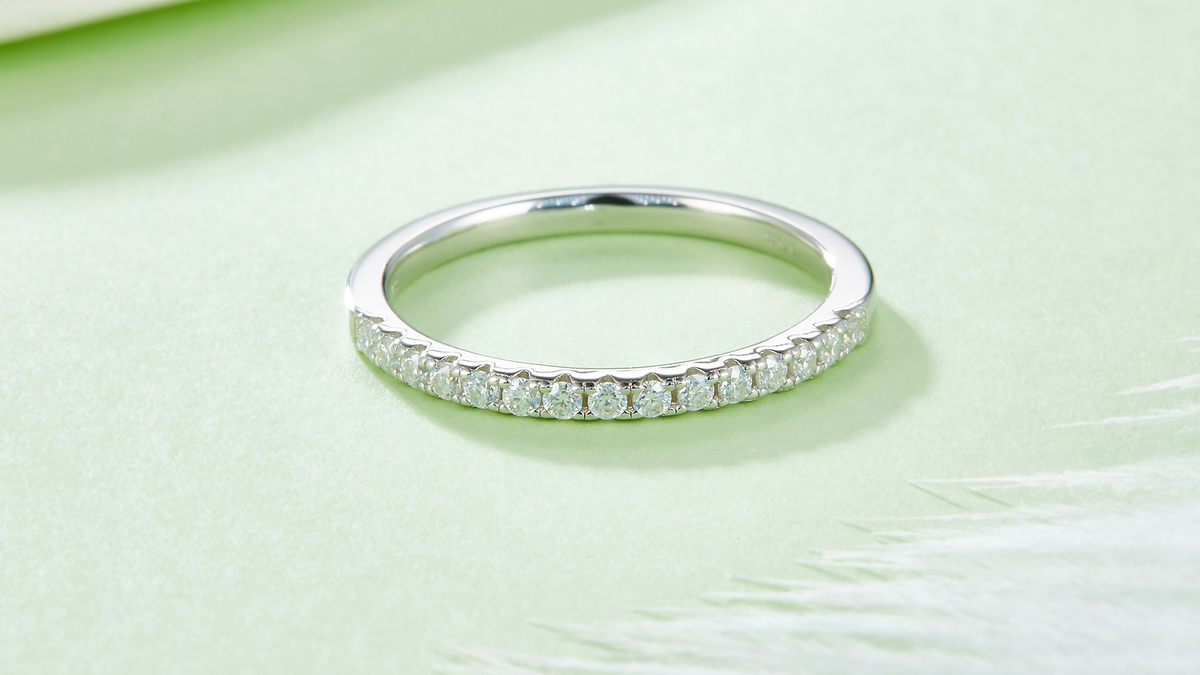
Yes. S925 sterling silver can be an excellent material for many jewelry products. Because it contains alloying metals in addition to silver, sterling silver is more practical for jewelry manufacturing than very high-purity silver.
It is especially suitable for:
· smaller moissanite stones
· lightweight jewelry
· fashion-forward collections
· entry-level price points
· products designed for accessible retail positioning
For independent jewelry brands, sterling silver can also be useful when developing affordable collections or testing new designs.
However, larger center stones require more careful structural planning.
A 2-carat, 3-carat, or larger gemstone places different demands on the prongs, basket, and ring shank than a small center stone.
This is why larger moissanite rings are often developed in 14K or 18K gold, particularly when long-term wear, premium positioning, and structural stability are priorities.
5. Why Is Moissanite So Much Harder Than Precious Metals?
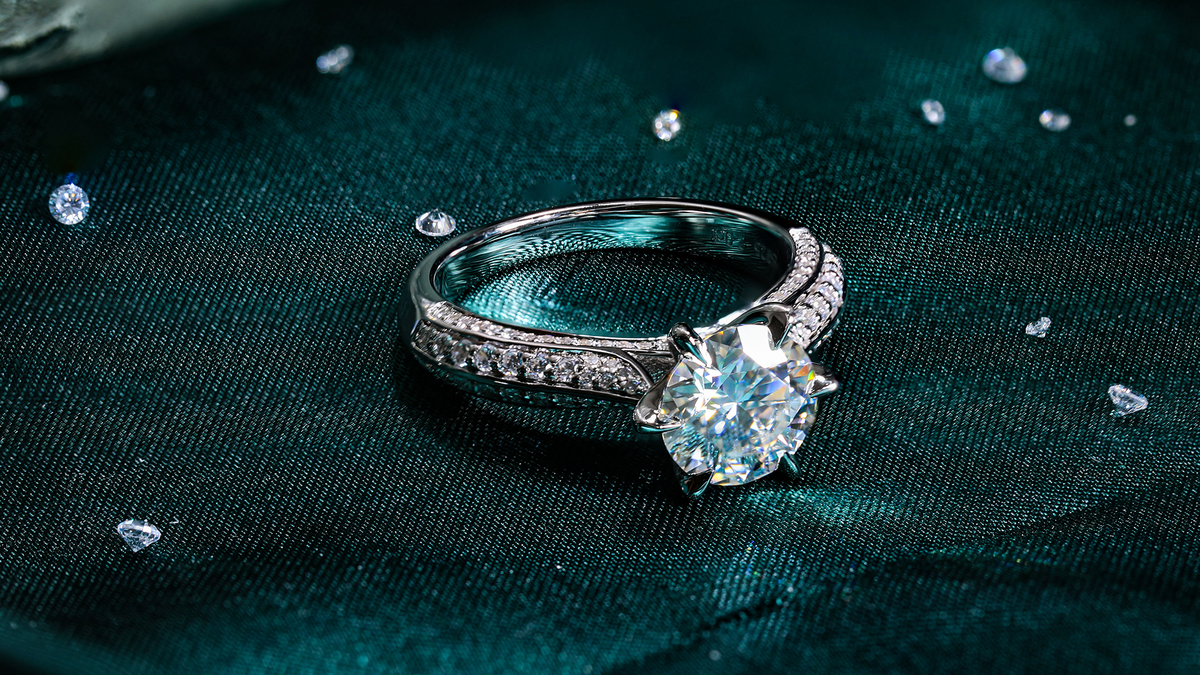
Moissanite is crystalline silicon carbide, a material with a Mohs hardness of approximately 9.25. That gives it excellent resistance to surface scratching.
Its hardness is dramatically higher than that of common precious metals such as gold, silver, and platinum. This is one reason moissanite performs very well in rings and other jewelry worn frequently.
Its polished facets can maintain their sharp appearance and optical performance over long periods of normal wear. But there is an important distinction:
High hardness does not mean a gemstone is impossible to damage.
Mohs hardness describes scratch resistance.
It does not directly describe fracture toughness.
Like other crystalline gemstones, moissanite can still chip or suffer edge damage under severe impact.
Precious metals behave differently.
Gold and silver are much softer, but they are also highly ductile.
When subjected to force, they are more likely to:
scratch, dent, bend, or deform
rather than fracture like a brittle crystal.
This is why jewelry durability should never be evaluated using Mohs hardness alone.
6. Does Higher Mohs Hardness Mean Better Jewelry?
Not necessarily. A durable piece of jewelry depends on several factors working together:
surface hardness + toughness + ductility + setting design + gemstone size + intended wear
For example, moissanite has much higher scratch resistance than 18K gold.
But a moissanite ring still depends on the metal setting to keep the stone secure.
If the prongs are too thin, the basket is poorly designed, or the ring structure is not suitable for the center stone, high gemstone hardness will not solve the problem.
For jewelry brands, the goal should not be to use the “hardest” material everywhere.
The goal is to make sure that:
the gemstone, metal, and setting structure are properly matched.
7. Can Moissanite Wear Down Gold Prongs?
Moissanite is significantly harder than gold alloys, but normal jewelry wear should not be understood as the gemstone rapidly “grinding away” the prongs.
In a properly designed setting, the gemstone and prongs remain relatively stable in relation to each other.
The more common long-term concerns are external impact, metal deformation, prong wear, and gradual loosening caused by daily use.
This is why periodic inspection of prongs is good practice, especially for rings with larger center stones.
8. Which Scratches More Easily: Gold or Silver?
Both high-purity gold and silver are relatively soft metals.
Sterling silver is more suitable for jewelry than fine silver because alloying improves its practical mechanical properties.
Likewise, 14K and 18K gold behave differently from 24K gold because of their alloy composition.
In daily wear, all precious metals can develop fine surface scratches.
These marks are generally considered normal wear rather than a sign of poor material quality.
Professional polishing can often restore the appearance of the metal when needed.
Frequently Asked Questions
1. Is 18K gold more durable than 24K gold?
For many gemstone-setting applications, yes. 18K gold generally offers better structural performance than 24K gold because alloying improves its mechanical properties. However, the final durability of a piece also depends on the design and manufacturing quality.
2. Is platinum harder than gold?
Platinum jewelry can offer excellent durability and stability, but the answer depends on the specific alloys being compared. Hardness alone should not be used to determine which metal is “better.”
3. Can sterling silver hold moissanite securely?
Yes, especially for smaller stones and lighter designs. For larger center stones, the full setting structure and intended use should be carefully evaluated.
4. Is moissanite harder than gold?
Yes. Moissanite has a Mohs hardness of approximately 9.25, while common jewelry gold alloys are much lower on the Mohs scale.
5. Can moissanite chip even though it is very hard?
Yes. Hardness measures resistance to scratching, not resistance to impact or fracture. Severe impact can still damage a gemstone.
Mosup View: The Right Material Matters More Than the Highest Hardness
Gold, silver, platinum, and moissanite serve very different functions in jewelry.
Moissanite needs high surface hardness to maintain its facets and visual performance.
Precious metals, on the other hand, need the right balance of workability, ductility, strength, stability, and finishing quality.
For jewelry brands, material selection should therefore consider more than a hardness number.
A more practical approach is:
Gemstone Size × Setting Structure × Metal × Target Price × Wearing Conditions
At Mosup, we manufacture moissanite, lab-grown diamond, and lab-grown gemstone jewelry in S925 sterling silver, 10K, 14K, 18K gold, and platinum.
For custom projects, material recommendations can be adjusted according to gemstone size, product structure, target market, and brand positioning.
Good jewelry design is not about using the hardest material everywhere. It is about using the right material in the right place.