
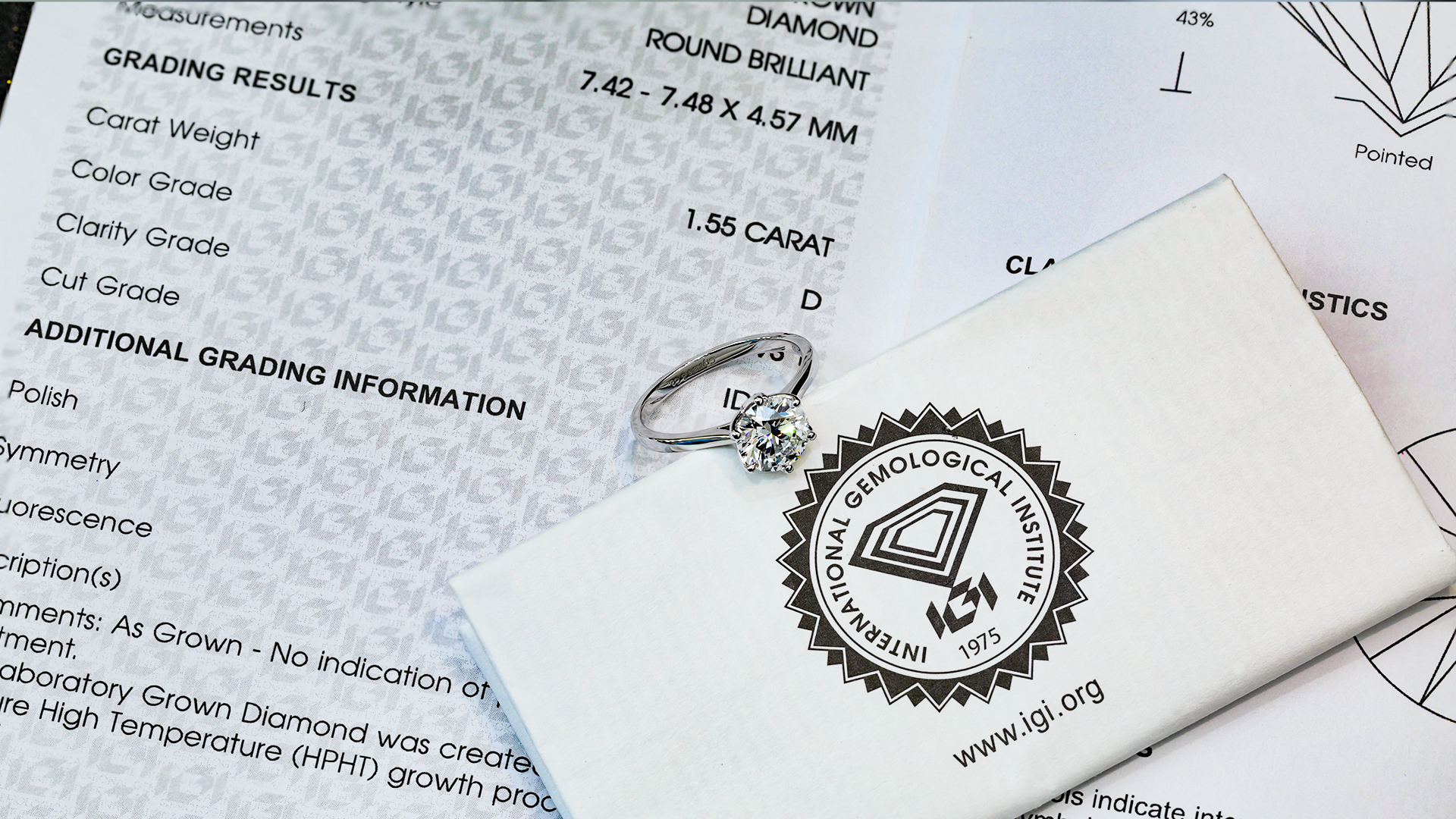
An IGI Laboratory Grown Diamond Report is useful because it gives buyers an independent record of what a diamond is and how its principal gemological characteristics were assessed. For a jewelry brand or wholesale buyer, however, the report becomes much more valuable when it is connected to the actual purchasing process rather than treated simply as a certificate handed to the final customer.
A report can document the diamond's laboratory-grown origin, measurements, carat weight, color, clarity and applicable cut information, together with additional details such as polish, symmetry and report comments. What it cannot do is confirm that an entire ring or necklace has been manufactured correctly. Metal, setting security, ring size, surface finish, engraving and packaging still belong to the finished-jewelry specification and QC process.
For B2B sourcing, the most useful question is therefore not simply, “Is this diamond IGI certified?” A better question is:
Does the IGI report match the diamond specification that was quoted, sampled, approved and ordered?
That distinction turns the report from a marketing document into a practical purchasing and traceability tool.
1. Understand What an IGI Lab-Grown Diamond Report Actually Confirms
An IGI Laboratory Grown Diamond Report begins by identifying the submitted stone and documenting the gemological characteristics applicable to that diamond. This usually includes the laboratory-grown origin, shape and cutting style, measurements and the main grading results.
For a retail customer, this information helps explain the stone. For a professional buyer, it performs an additional role: it creates a documented reference that can be connected to the supplier quotation, purchase order, approved sample and internal SKU.
That connection matters when a brand buys multiple stones or places repeat orders. A product described internally as a “2 ct oval lab-grown diamond ring” is still too broad for consistent sourcing if the company does not know which measurements, color range, clarity range and report requirements were originally approved.
1.1 Report Number and Diamond Identity
Every IGI report has its own report number. Where individual stone traceability is required, the buyer can record this number alongside the relevant SKU or purchase order so the physical diamond, supplier documents and internal inventory record remain connected.
The description should also clearly identify the stone as a laboratory-grown diamond. Natural diamond, laboratory-grown diamond and diamond simulants are different product categories and should not be used interchangeably in quotations, website descriptions or customer-facing documentation. For a wholesale buyer, accurate identity is the starting point for everything that follows.
2. Read Measurements Together With Carat Weight
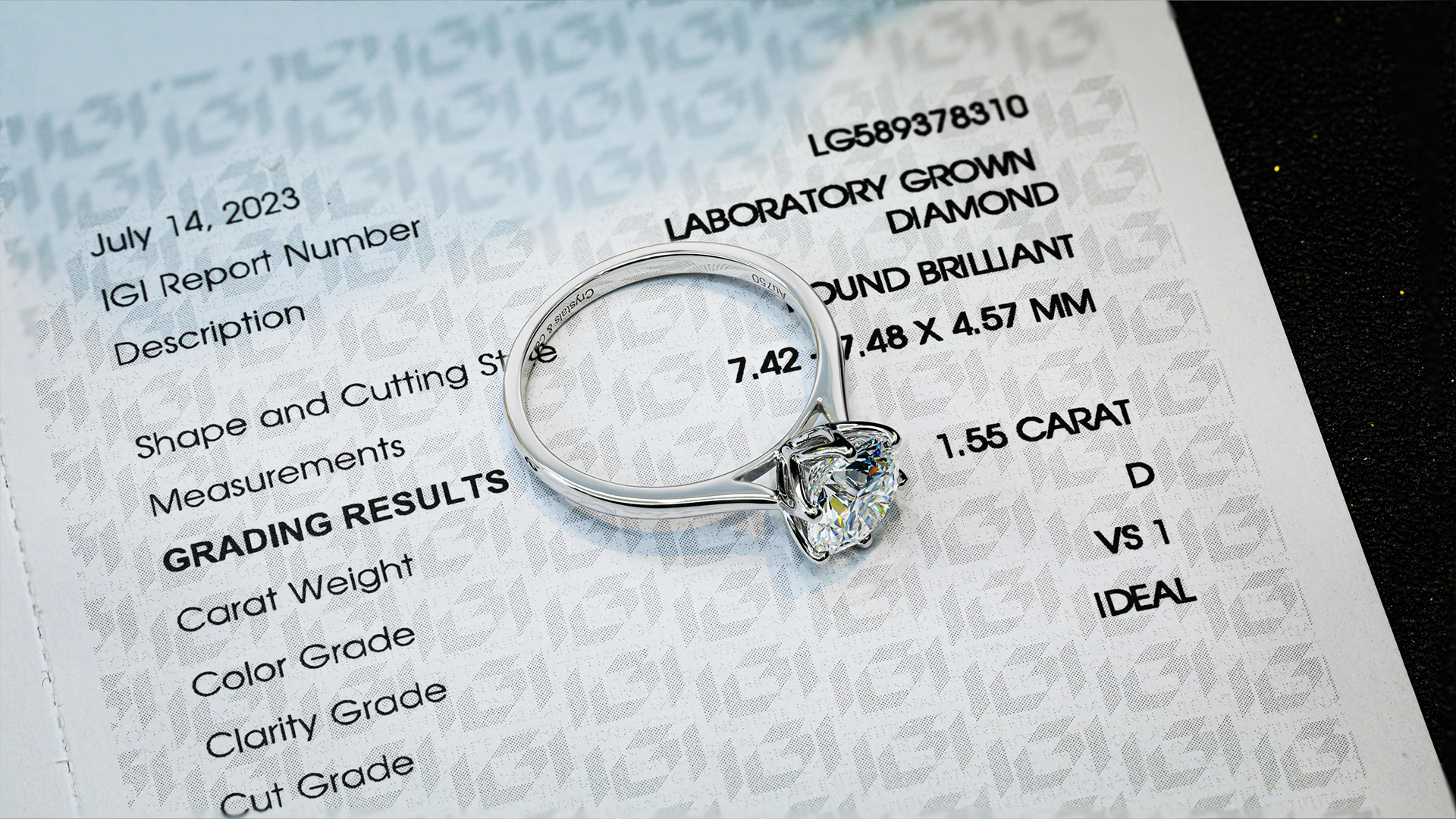
Carat weight is one of the first values buyers notice, but it should never be read in isolation. Jewelry is manufactured around the physical dimensions of a stone, not simply the number of carats printed on a report.
A round diamond may be recorded by diameter and depth, while an oval, emerald, pear or other fancy shape will typically be described using length, width and depth. Two diamonds can share the same nominal carat weight while having noticeably different face-up dimensions or proportions. This matters directly in production. A ring setting that was developed around one approved oval stone may not produce the same appearance if a future stone has a very different length-to-width ratio, even when both stones are sold at the same carat weight.
2.1 Why Measurements Matter for Repeat Orders
For wholesale jewelry, the stronger specification is often:
Shape + Carat Weight + Physical Measurements
rather than carat weight alone. This becomes especially important for bridal rings, matched earrings and multi-stone designs. If a sample has already been approved, recording its stone measurements gives the supplier and buyer a more practical reference for later production.
MOSUP works with both ready-stock products and custom jewelry development. For custom projects, CAD and sample approval can be used together with the stone specification so the setting, stone dimensions and finished proportions are reviewed as one product rather than as separate components.
3. Use the 4Cs as Purchasing Specifications, Not Just Quality Labels
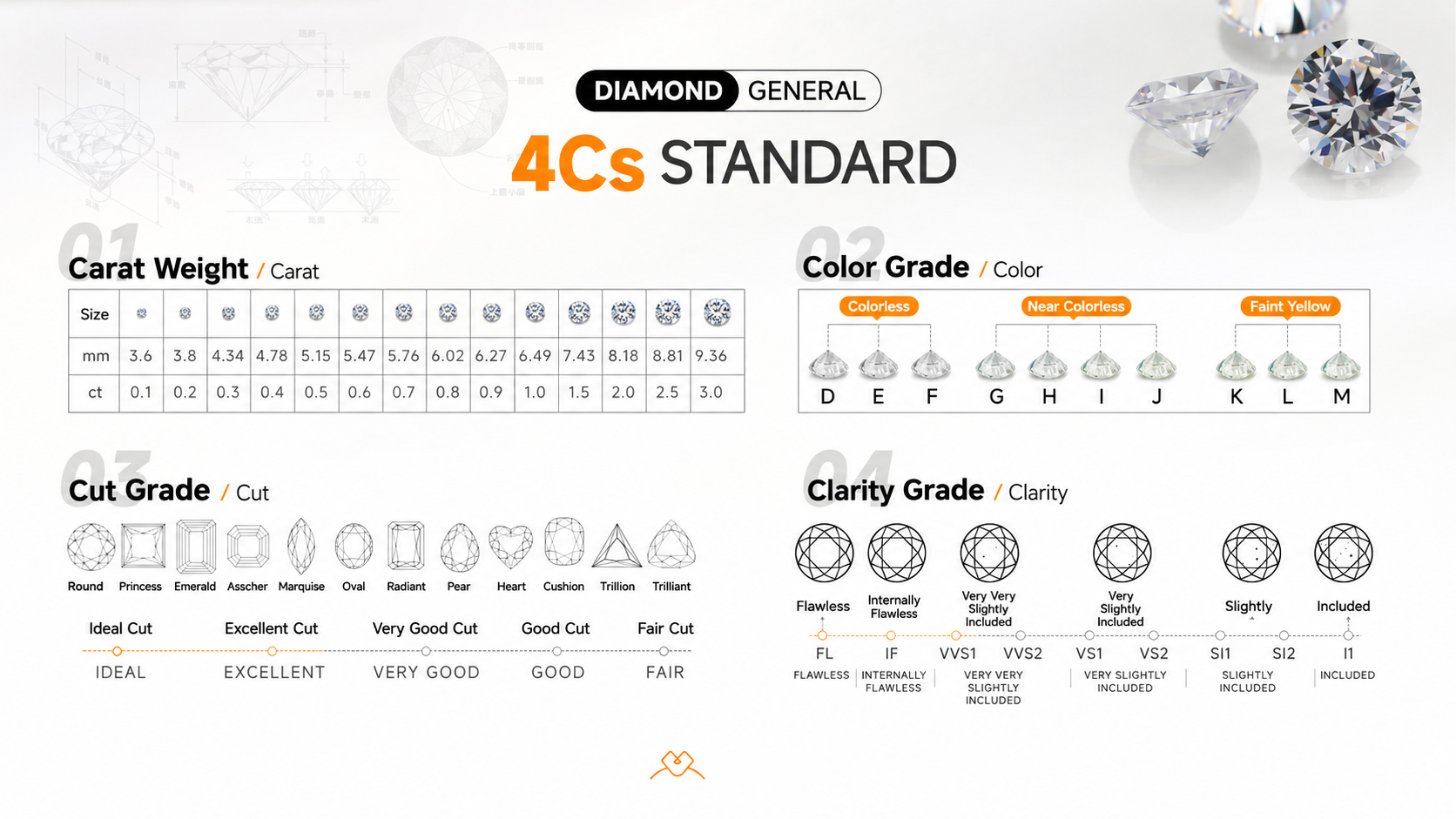
The familiar 4Cs—carat, color, clarity and cut—remain central to diamond grading, but a B2B buyer should interpret them differently from a consumer shopping for a single stone. For a brand, these grades form part of a product specification that needs to support the desired retail price, visual result, margin and future availability. The highest possible grade is not automatically the best commercial choice.
3.1 Color and Clarity Should Match the Product Position
A higher-positioned bridal line may use a tighter color and clarity range, while another collection may choose a different combination if the visual appearance still supports its target customer and retail price. Clarity also needs to be considered together with shape and size. Internal characteristics that are difficult to notice in one design may be more visible in a large step-cut stone such as an emerald cut.
This is why a professional buyer should not simply request “the highest grade.” The more useful question is whether the selected specification produces the appearance and price position the collection actually needs.
3.2 Cut, Polish and Symmetry Add More Context
Cut should not be confused with shape. Shape describes the outline of the stone, while cut grading relates to how effectively the diamond has been fashioned and how its proportions and craftsmanship contribute to visual performance. Polish and symmetry provide additional information about the workmanship of the finished diamond. These values are useful, but they should still be read as part of the complete stone specification rather than treated as isolated purchasing decisions.
For wholesale buyers, consistency across repeat orders is often more commercially important than finding one unusually attractive stone.
4. Read Growth Method, Treatment and Comments in Context
The comments section of a lab-grown diamond report deserves attention because it may provide information about how the diamond was produced and whether relevant post-growth treatment was detected or reported. CVD and HPHT are the two principal laboratory diamond growth methods. They explain how a diamond was created, but they are not complete quality grades. A CVD-grown diamond is not automatically better than an HPHT-grown diamond, and the reverse is equally misleading.
For sourcing purposes, growth method should therefore be considered alongside the final diamond specification—measurements, carat, color, clarity, cut, appearance and documentation.
4.1 Growth Method Is Not the Same as Finished Quality
This distinction is particularly important when purchasing departments compare suppliers. One supplier may promote CVD while another offers HPHT, but the growth method alone does not tell the buyer whether the two stones have comparable specifications or commercial value.
A professional comparison needs to look at the complete report and the final jewelry requirement. For brands that need a broader explanation of how growth method affects purchasing, this section should link to the MOSUP Wholesale Lab-Grown Diamond Jewelry Sourcing Guide, where CVD and HPHT are discussed as part of the wider sourcing process rather than as isolated grading labels.
5. Verify the Report, Laser Inscription and Type of IGI Document
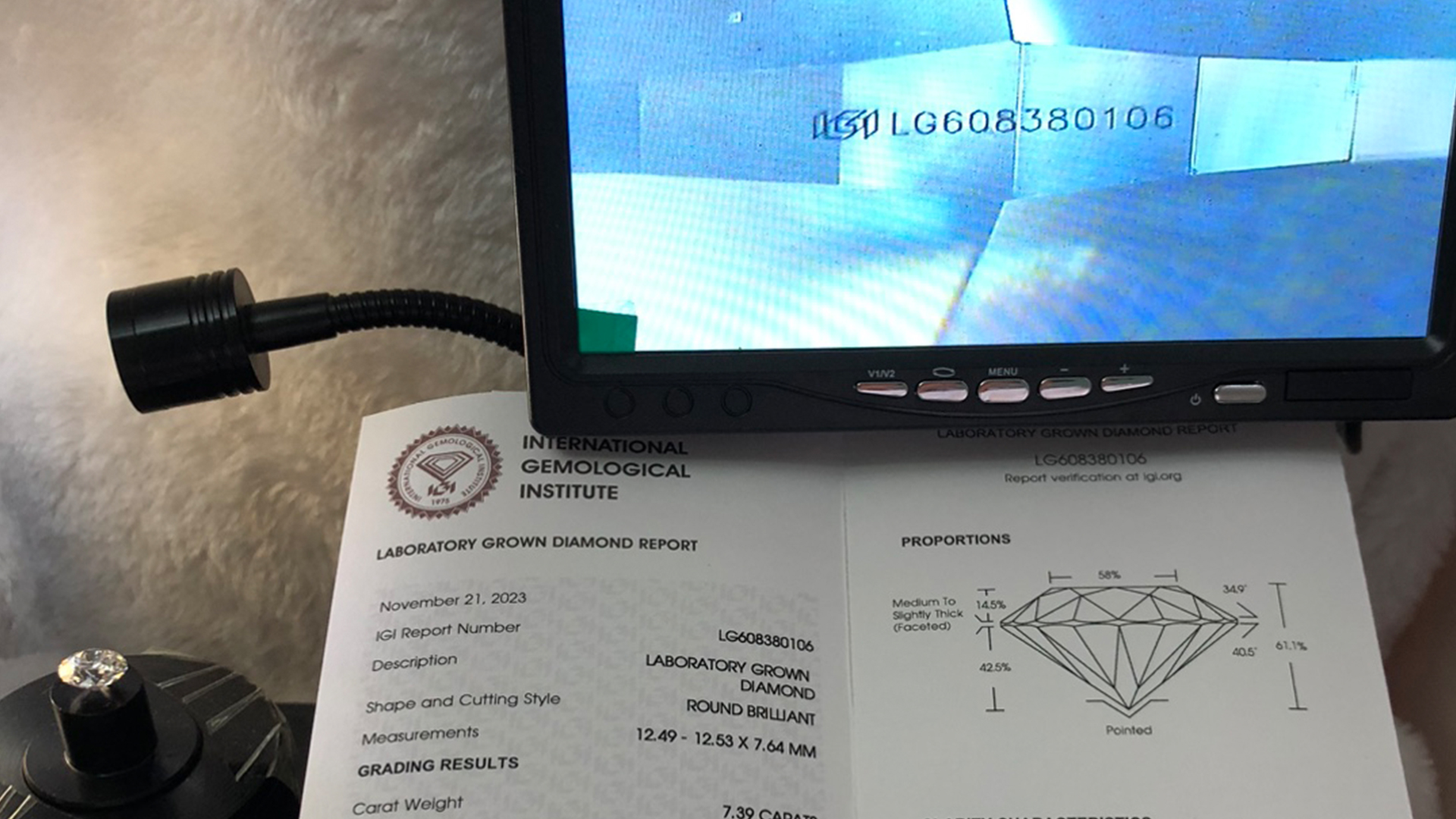
An IGI report should be verifiable rather than simply accepted as a PDF supplied by another party. IGI provides report verification, allowing the report number to be checked against its digital record. Where the report number is laser-inscribed on the diamond's girdle, that inscription can also provide an additional traceability point between the physical stone and its documentation.
For B2B purchasing, this becomes useful when individual center stones need to remain traceable through sample approval, incoming inspection, production or final QC.
5.1 Loose Diamond Report vs. Finished Jewelry Report
Buyers should also confirm what type of IGI document they are reviewing. A loose stone can be examined without a setting obstructing the grader's view. A diamond that is already mounted in a ring, pendant or other finished piece may have limitations because parts of the stone are covered by the setting.
For finished jewelry, certain characteristics may therefore be assessed “as mounting permits.” In those situations, some grades may be recorded as ranges rather than as the same exact values that could be determined on a loose diamond. This difference is commercially important. A loose-stone report and a finished-jewelry report should not automatically be compared field-for-field as though they represent identical examination conditions.
6. Know What an IGI Report Does Not Tell You About Finished Jewelry
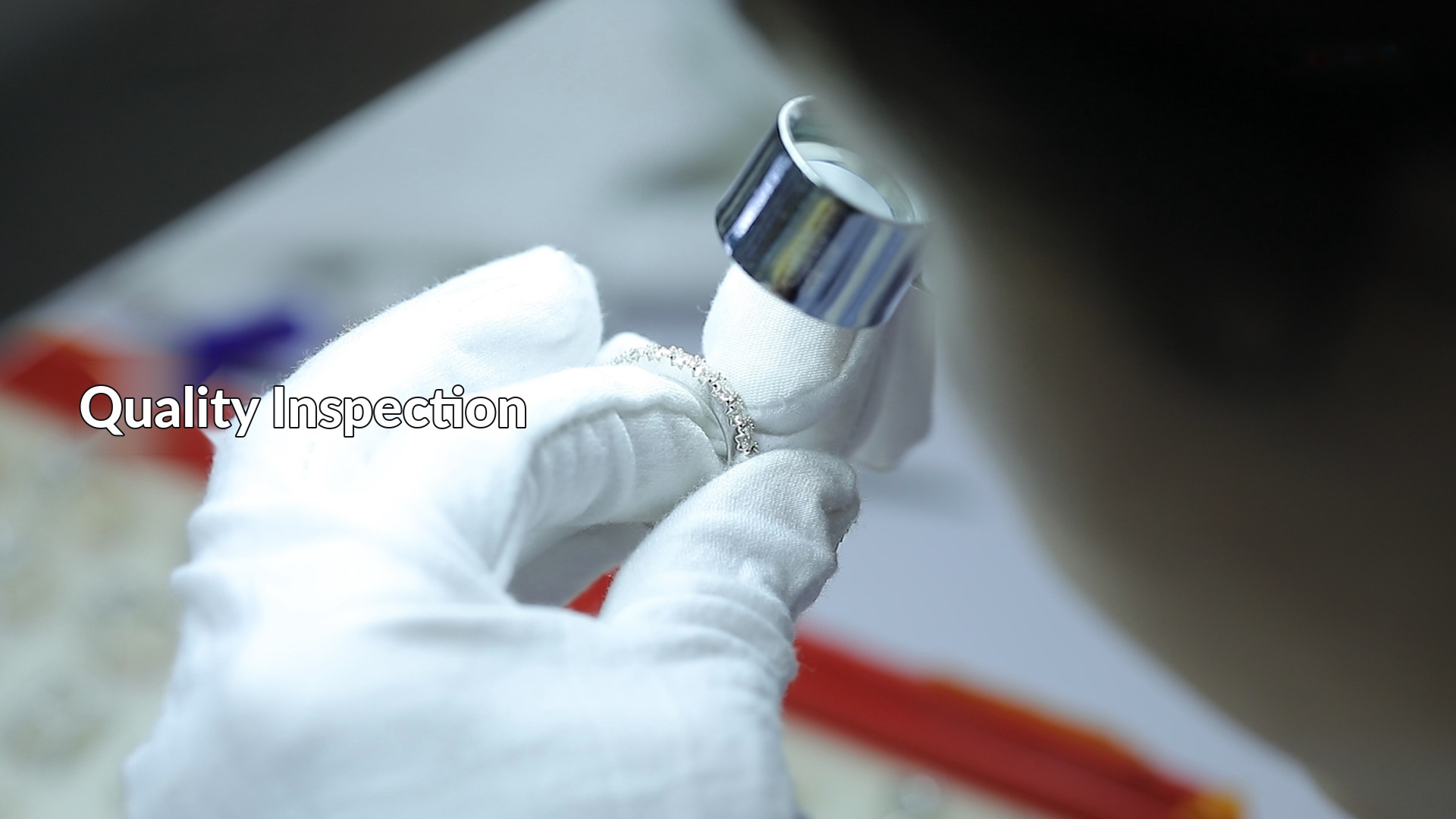
A grading report documents the diamond. It does not approve the entire piece of jewelry. This is one of the most important distinctions for wholesale buyers.
Even when the center stone matches the required report, the finished product may still have manufacturing issues. A ring may have an incorrect size, uneven prongs or a poorly finished surface. Earrings may not match as a pair. A necklace clasp may not function correctly, or private-label packaging may not match the approved version.
None of those problems is resolved by the existence of an IGI report. A complete B2B quality process should therefore separate diamond documentation from finished-jewelry inspection.
MOSUP's current quality process includes production inspection and pre-shipment inspection as part of its supply-chain workflow. For a custom project, final QC can compare the finished piece against the approved stone specification, CAD or sample, metal, size, branding and packaging requirements.
The practical relationship is: IGI Report → Product Specification → Approved Sample → Finished-Jewelry QC not: IGI Report = Finished Jewelry Approved This section should naturally link to MOSUP's Pre-Shipment Jewelry Inspection Guide for buyers who need a more detailed QC framework.
7. Use the IGI Report Throughout the RFQ, Sample and Reorder Process
The report becomes most useful when its information is incorporated into the purchasing documents rather than kept separately after the transaction. At the RFQ stage, the buyer should state whether an IGI report is required and define the diamond specification that needs to be quoted. Shape, carat or dimensions, color, clarity, cut requirements and report scope should be clear enough for different suppliers to quote comparable products.
During sample development, the relevant report number can be recorded together with the approved product specification where individual stone traceability is required. The approved sample can then establish the relationship between the diamond, setting, metal, size, finish and other product details.
When production moves into final QC, the documentation can be checked again where required, while the finished jewelry receives its own separate inspection. For repeat orders, the previous specification and approved sample become the commercial benchmark. The goal is not for every future diamond to be microscopically identical, but for each order to remain within the agreed specification and visual range for that SKU.
7.1 A Practical B2B Report Checklist
| Report Field | What the Buyer Should Confirm | Why It Matters |
|---|---|---|
| Description | Laboratory-grown diamond identity | Prevents product-description errors |
| Report Number | Correct and verifiable | Traceability |
| Shape | Matches the ordered design | Setting compatibility |
| Measurements | Fits approved dimensions | Production consistency |
| Carat | Matches target weight | Price and positioning |
| Color | Within approved range | Appearance and pricing |
| Clarity | Within approved range | Appearance and pricing |
| Cut | Applicable grade/assessment | Visual performance |
| Polish & Symmetry | Meets required specification | Stone workmanship |
| Comments | Growth/treatment information where provided | Documentation |
| Laser Inscription | Matches report where required | Physical traceability |
This type of checklist is more useful to a purchasing team than simply asking whether a stone is “IGI certified.”
8. How MOSUP Handles IGI Requirements in Wholesale and Custom Projects
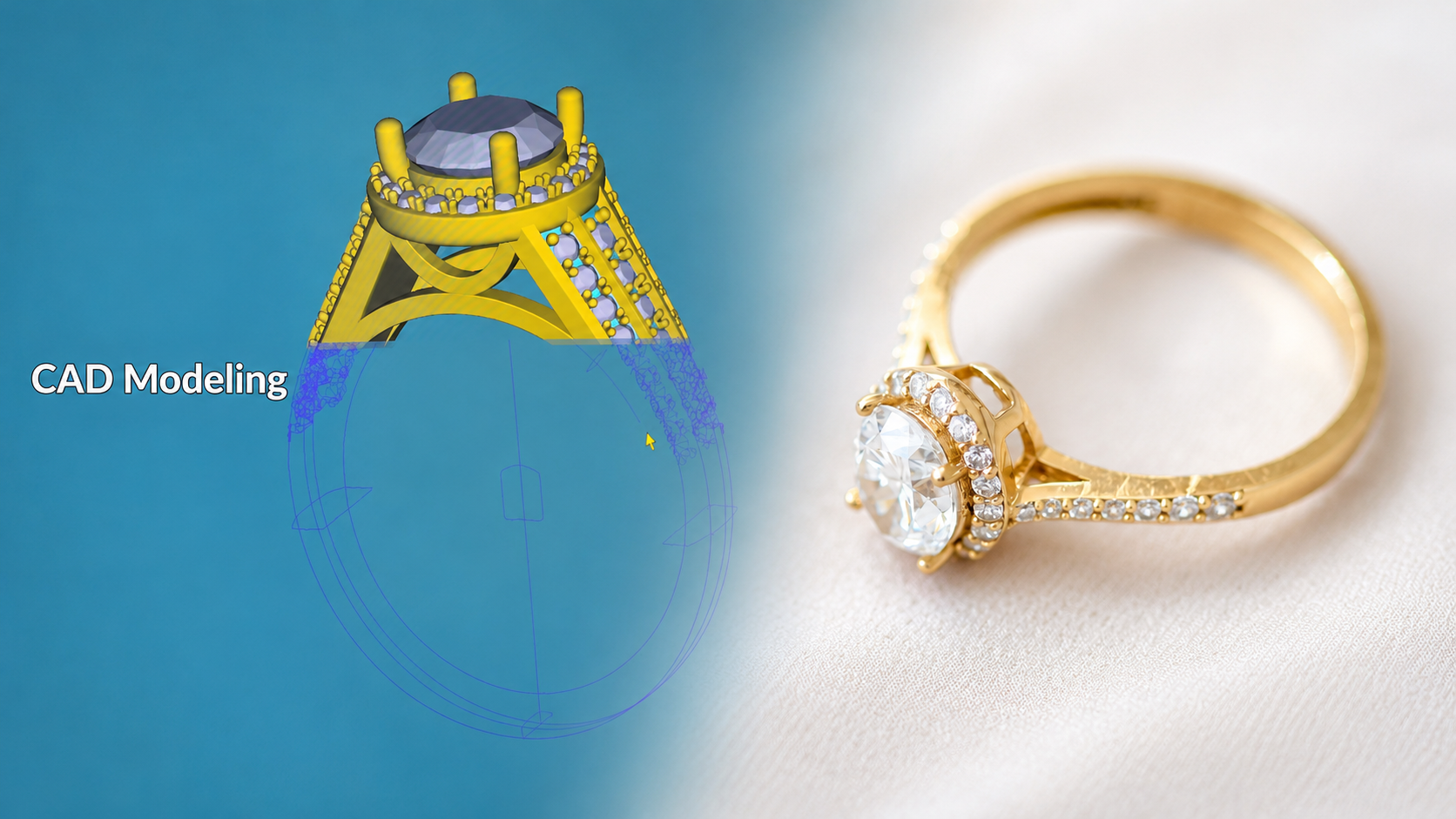
MOSUP serves jewelry brands, retailers and wholesalers through both ready-stock purchasing and custom development. Its current business model includes a large ready-stock assortment, sample orders, CAD development, design modification, OEM/ODM, private-label requirements, packaging customization and international fulfillment. The website also describes two stages of quality checking within its production and shipping process.
For a lab-grown diamond project, an IGI requirement should therefore be treated as one part of the product specification rather than assumed for every SKU. A buyer should confirm before quotation whether individual reports are needed, which center stones require them, what color and clarity range should be sourced, and whether report numbers need to be recorded against the physical products.
Brands that are still testing a collection can begin with MOSUP's available jewelry assortment and evaluate product direction before committing to deeper customization. Current ready-stock purchasing is designed to support relatively fast product testing, while custom projects can move into material changes, CAD, sample development and private-label details when more differentiation is required.
For custom development, buyers may provide reference images, samples or design files. MOSUP's current site also describes CAD/ZB/Rhino modeling, one-piece sample development for suitable projects, hand stone setting, polishing/plating and two-stage QC as part of its broader service system. The important point is that the diamond report, jewelry specification and manufacturing requirement should all be confirmed in the same project scope.
This section should contain three commercial links:
MOSUP Lab-Grown Diamond Jewelry → product/category page
MOSUP Custom Jewelry Development → custom page
Request a Project-Specific Quotation → contact page
9. Frequently Asked Questions About IGI Lab-Grown Diamond Reports
9.1 Does an IGI Report Confirm That a Diamond Is Laboratory Grown?
Yes. IGI examines submitted stones to determine whether they are laboratory grown, natural or another material and records the applicable identity in the report.
9.2 Does the Report Show Whether a Diamond Is CVD or HPHT?
Depending on the report and service, information about the growth process and detected treatments may appear in the report comments. Buyers should read this information as technical documentation rather than as a simple quality ranking.
9.3 Is an IGI Report the Same as a Jewelry Appraisal?
No. A grading report documents gemological characteristics. It does not by itself provide a retail or resale valuation.
9.4 Can an IGI Report Be Verified Online?
Yes. The report number can be checked through IGI's report-verification service, which is useful when a brand needs to confirm that the document corresponds to an authentic IGI record.
9.5 What Does “Graded as Mounting Permits” Mean?
It means the diamond was assessed while mounted in jewelry and the setting limited how completely certain characteristics could be observed. Some grading information may therefore be reported as ranges.
9.6 Does an IGI Report Replace Finished-Jewelry QC?
No. The report describes the diamond. Finished-jewelry QC still needs to check the metal, setting, dimensions, functionality, surface finish, branding and packaging.
9.7 Should Every Lab-Grown Diamond Jewelry SKU Include an IGI Report?
Not automatically. Report requirements should be confirmed according to the product, center stone, commercial positioning and order requirements before quotation.
9.8 What Should a Buyer Send a Supplier When IGI-Reported Diamonds Are Required?
Provide the product reference, stone shape, target carat or dimensions, color, clarity, cut requirement where relevant, quantity, metal and a clear statement that an IGI report is required. This allows the supplier to quote the correct scope. For B2B buyers, the value of an IGI report is not simply that the document exists. Its value comes from using the information consistently across the quotation, sample approval, QC and repeat-order process.
When the report, physical diamond and finished-jewelry specification remain connected, the buyer gains a much clearer record of what was ordered and what needs to be reproduced later. That is the more useful way to read an IGI report—not only as a grading document, but as one part of a repeatable jewelry sourcing system.


