
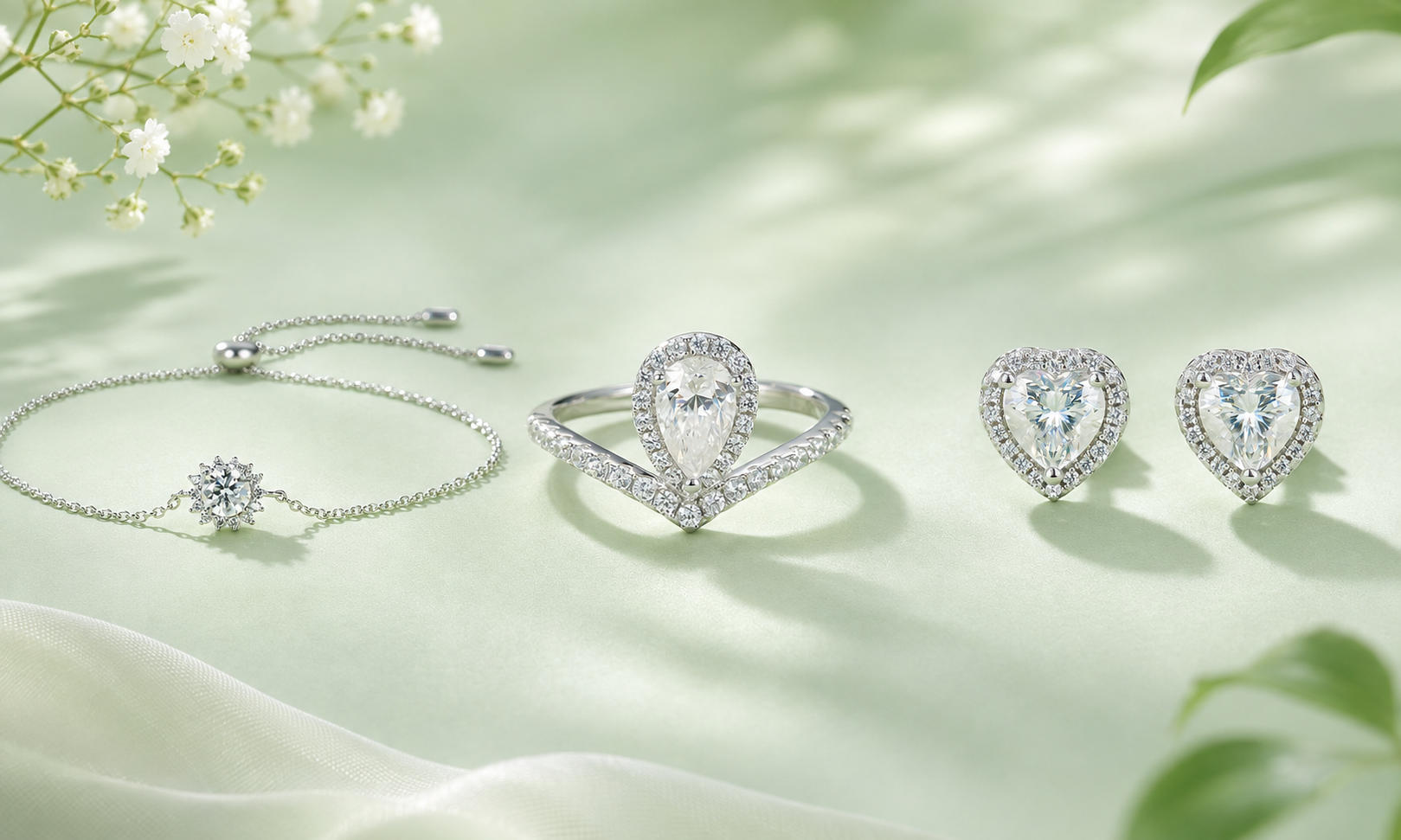
For jewelry brands and retailers, sourcing lab-grown diamond jewelry is not simply a matter of asking a supplier for “D color, VVS clarity and the best price.” A commercially sound purchase requires several decisions to work together: the diamond specification, the finished-jewelry specification, the approved sample, the production standard and the way the same product will be reproduced on a future order.
The center stone may be the most visible part of the product, but it is only one part of the sourcing decision. A buyer also needs to define the metal, setting, dimensions, finish, branding, packaging and documentation requirements. Once the first sample is approved, those details need to remain clear enough for production and QC teams to reproduce the product consistently.
A practical wholesale sourcing process therefore looks like this: Diamond Specification → Jewelry Specification → Sample Approval → Production & QC → Reorder Standard This is why a low unit price without a clearly defined scope is not a complete quotation. The purpose of this guide is to help jewelry brands, retailers, wholesalers and private-label buyers turn a general inquiry into a product specification that can actually be quoted, sampled, inspected and reordered.
1. Define the Product Before Requesting a Quote
The quality of a supplier's quotation depends heavily on the quality of the buyer's brief. A request such as “Please quote a 2 ct lab-grown diamond ring” may sound specific, but it still leaves many commercial and technical questions unanswered.
The center stone could be round, oval, emerald or another shape. The 2 ct requirement may refer to an exact carat weight or simply to a visual size. Color and clarity ranges may not yet be defined. The buyer may or may not require an IGI report. The ring could be S925 sterling silver, 10K, 14K or 18K gold, and the project may also involve ring sizing, logo engraving or custom packaging. Until these details are confirmed, two quotations can appear comparable while actually describing different products.
1.1 What Information Should Be Included in a B2B Jewelry RFQ?
A more useful RFQ should identify the product type, diamond shape, target carat weight or dimensions, color range, clarity range, cut requirements, metal, finish, quantity, sizing, branding, packaging and documentation requirements. The buyer should also explain the commercial role of the product. A sterling-silver ring being tested by a new ecommerce brand is a different sourcing project from a 14K bridal ring intended to become a long-term core SKU. That difference affects more than price. It can influence the appropriate diamond specification, metal choice, inventory commitment, report requirements and expected level of repeatability. The clearer the product's intended market position is, the easier it becomes to choose a commercially sensible specification rather than simply requesting the highest available grade.
2. Understand CVD and HPHT Without Treating Them as Quality Grades
CVD and HPHT describe how a laboratory-grown diamond was produced. They do not, by themselves, tell a buyer whether one finished diamond is better than another. For wholesale sourcing, this distinction matters because growth method is often oversimplified into a purchasing shortcut. Buyers may hear that CVD is always better than HPHT, or the reverse. Neither statement is a reliable procurement rule.
A finished CVD-grown diamond and a finished HPHT-grown diamond still need to be evaluated according to their actual characteristics, including carat weight, physical dimensions, color, clarity, cut, polish, symmetry, appearance, report information, availability and price.
2.1 Does Growth Method Determine Diamond Quality?
No. Growth method is one technical characteristic of the diamond, not a complete quality assessment. A buyer should also distinguish between growth method and post-growth treatment. These are separate pieces of information, and both may be relevant depending on the product specification and documentation requirements.
For commercial sourcing, the more useful question is not: “Is CVD better than HPHT?” It is: “Does this diamond meet the specification, appearance, documentation and price position required for this product?” That question keeps the focus on the finished product rather than on one technical label.
3. Use the 4Cs as Commercial Specifications, Not as a Ranking Contest
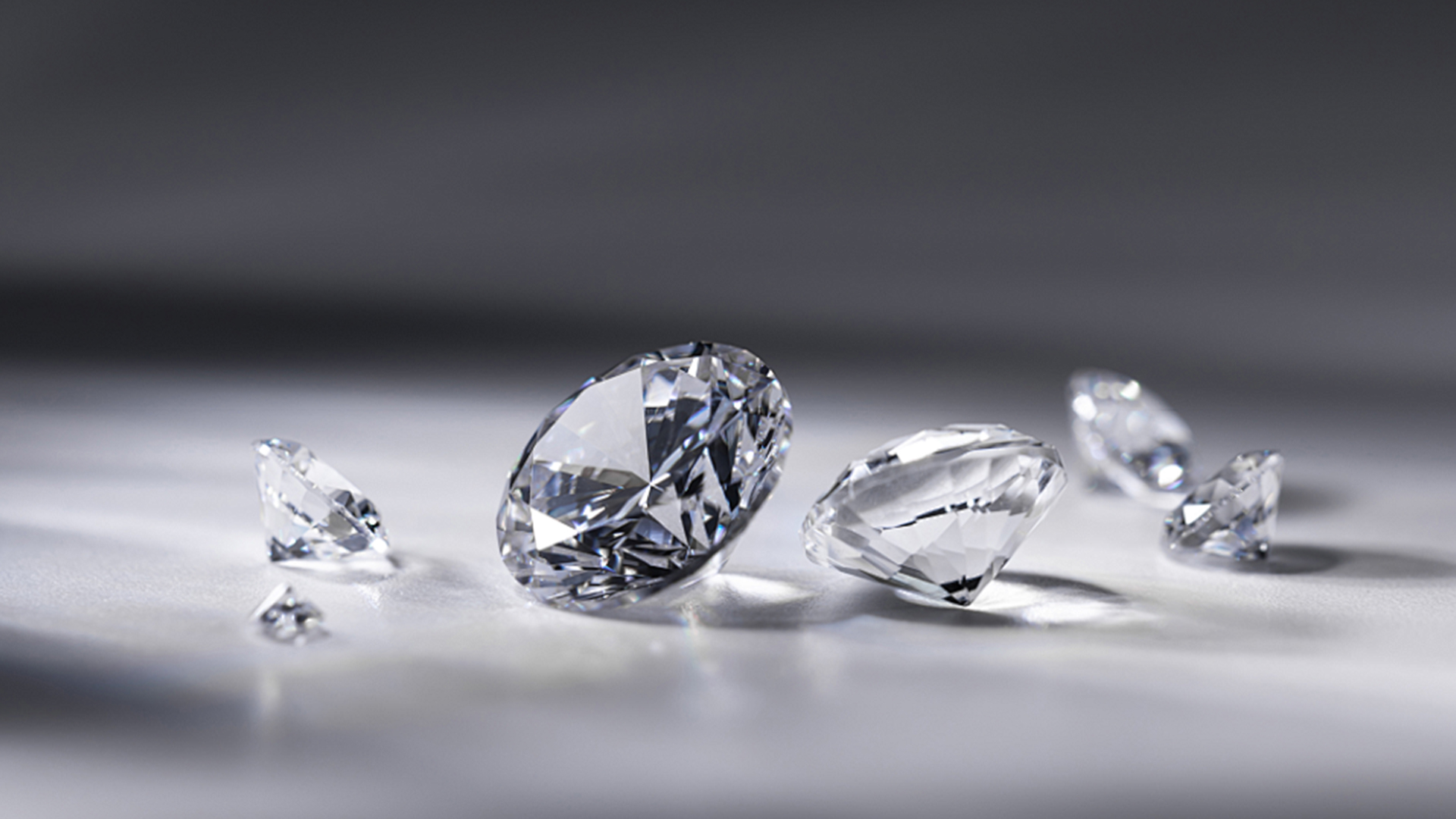
The 4Cs—carat, color, clarity and cut—remain important when sourcing laboratory-grown diamonds, but wholesale buyers should use them as product specifications rather than treating them as a simple hierarchy in which higher always means better. For a retailer, the most appropriate diamond is the one that fits the product's design, retail price, target customer and margin while remaining practical to source again.
3.1 Carat: Record Weight and Physical Dimensions
Carat describes diamond weight, but jewelry manufacturing also depends on physical dimensions. Two diamonds with the same carat weight can have different measurements and proportions. That matters because the setting is built around the actual stone, not around the number printed in the product description.
For repeat production, buyers should therefore record relevant dimensions alongside carat weight, particularly when a specific visual proportion has already been approved. This becomes even more important for matched earrings, side stones and multi-stone jewelry, where visual consistency between stones may matter more than an isolated carat figure.
3.2 Color: Match the Grade to the Product Position
Color grade affects appearance, cost and market positioning. A bridal brand operating at a higher retail price may choose a tighter color range, while a more price-sensitive jewelry collection may use a different specification if the finished appearance still suits the brand. The commercial question is not simply: “What is the highest color grade available?” A more useful question is: “What color range gives this product the appearance, price and margin required for its target market?”
3.3 Clarity: Consider What the Customer Will Actually See
Clarity should also be evaluated in the context of the finished piece. A very high clarity grade can increase cost without necessarily creating a meaningful visual improvement for every product. At the same time, internal features may become more noticeable in larger stones or in step-cut shapes such as emerald cut. The buyer should therefore consider clarity together with stone shape, size, setting and target retail position rather than purchasing clarity as an isolated specification.
3.4 Cut: Look Beyond a Single Attractive Stone
Cut influences the visual performance of the diamond and the overall appearance of the jewelry. For round brilliant diamonds, standardized cut information can be useful. Fancy shapes require a more nuanced review of proportions, outline, symmetry and visual balance. For wholesale buyers, however, one additional issue matters just as much: repeatability. One exceptionally attractive diamond does not establish a reliable product standard. The more important question is whether the supplier can continue sourcing stones that fall within the approved visual and technical range.
3.5 The Highest Grade Is Not Always the Best Commercial Choice
For a retailer, the strongest specification is usually the one that balances: Customer Expectation + Retail Price + Product Design + Target Margin + Reorder Availability That framework is more useful than automatically selecting the highest possible combination of color and clarity.
4. Decide Early Whether an IGI Report Is Required
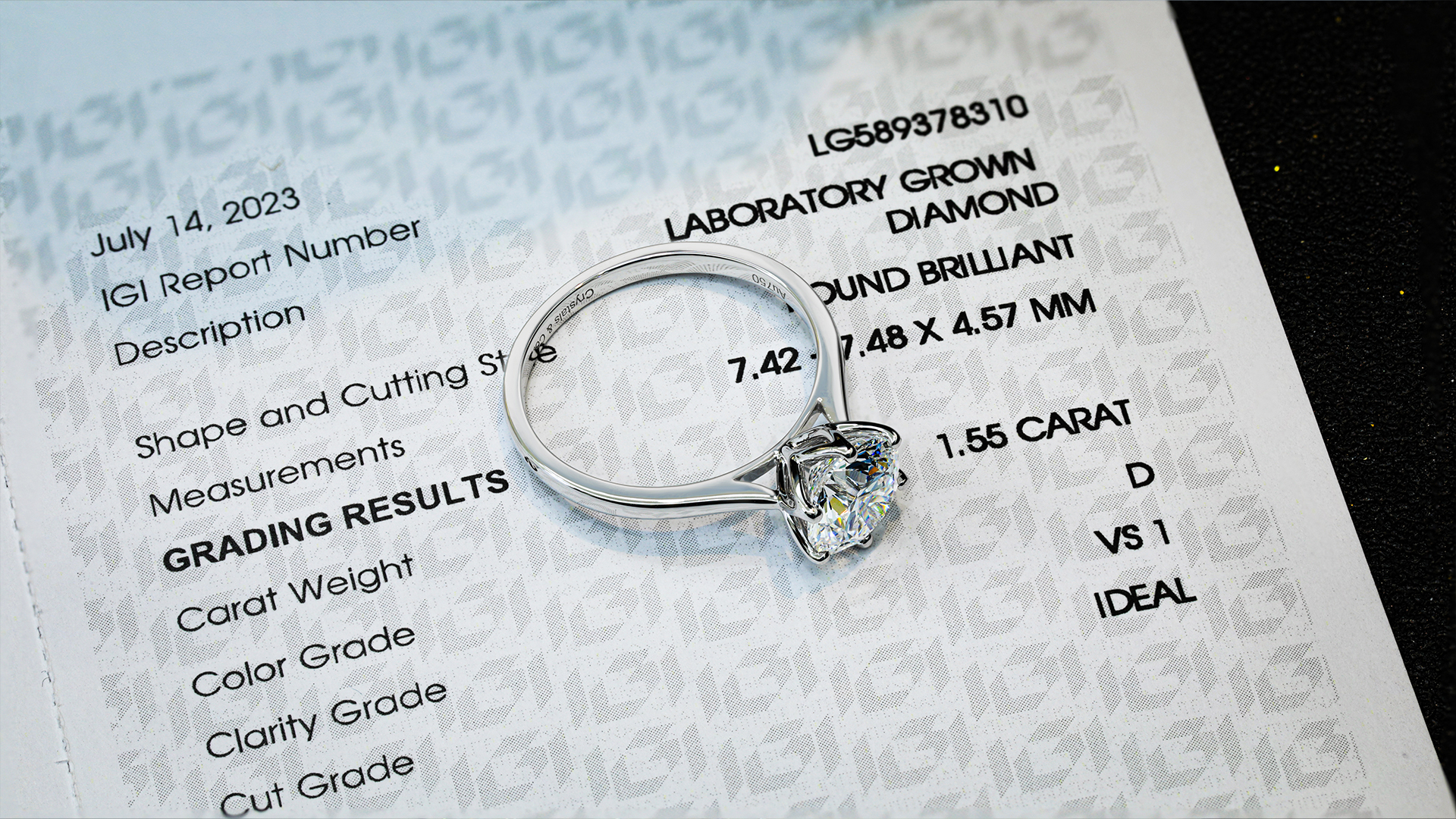
An IGI report can provide independent documentation of a laboratory-grown diamond's gemological characteristics, but the report and finished-jewelry QC serve different purposes. For B2B sourcing, the buyer should decide whether an independent report is required before the quotation is finalized. This avoids situations in which certification becomes an unexpected cost or lead-time issue at the end of production.
4.1 What Should Buyers Confirm About IGI Reports?
The buyer should establish whether a report is required for every center stone, whether the requirement applies to a loose stone or mounted jewelry, whether the report number must correspond to a specific physical stone, and whether the documentation affects cost or delivery timing. The brand should also consider how the report will be used commercially. Some retailers may need the information for product pages, sales training or customer service, while others may not require individual reports for every product category.
The important point is not to assume that every lab-grown diamond jewelry SKU automatically includes the same report. Likewise, an IGI report does not tell the buyer whether the ring size is correct, whether the prongs are secure, whether the metal has been finished properly or whether the correct packaging has been used. Those issues belong to finished-jewelry quality control. A dedicated supporting article on How to Read an IGI Lab-Grown Diamond Report for Wholesale Buying can explain report numbers, measurements, the 4Cs and report verification in greater detail without making this Pillar unnecessarily technical.
5. Choose the Metal According to the Product's Commercial Position
Metal choice should be treated as a product-positioning decision rather than simply as a material upgrade. S925 sterling silver can be useful for selected entry-price products, ecommerce testing, gifting categories and brands that want to validate demand before committing more capital to higher-value inventory. Gold changes both the cost structure and the retail position of the product. 10K, 14K and 18K contain different proportions of gold and therefore create different material costs, customer expectations and merchandising opportunities.
5.1 When Does S925 Make Sense?
S925 sterling silver can be a practical option when the goal is to test a product direction with lower inventory exposure. For example, a startup may use a sterling-silver lab-grown diamond ring to test demand for a particular stone shape or setting before developing the same design in gold. This approach can be especially useful when the brand is still learning which products, sizes and price points its customers are willing to buy.
5.2 When Does K-Gold Make More Sense?
Bridal and fine-jewelry collections may be better suited to 10K, 14K or 18K gold when the metal itself is part of the product's perceived value and long-term positioning. That does not mean gold is automatically the right answer for every SKU. The buyer should compare target retail price, product category, center-stone value, customer expectations, production cost and inventory exposure before choosing a metal. The most expensive option is not always the most commercially effective one.
6. Use Ready Stock and Custom Development for Different Stages of Growth
Ready-stock and custom sourcing solve different business problems, and a growing jewelry brand does not necessarily need to choose only one. Ready stock is useful when the priority is speed, market testing and lower development commitment. ODM becomes useful when a brand has validated a product direction but wants greater differentiation. OEM is more appropriate when the brand has a clear design language and is ready to develop a proprietary product.
| Factor | Ready Stock | ODM / Modified Existing Design | OEM / Original Development |
|---|---|---|---|
| Best Use | Market testing and faster launch | Differentiating a validated product | Building a proprietary collection |
| Development Work | Low | Medium | Higher |
| Design Differentiation | Limited | Moderate to high | Highest |
| Sample Need | Depends on buying strategy | Recommended | Strongly recommended |
| Inventory Risk | Lower for early testing | Moderate | Higher if demand is untested |
| Branding | Project dependent | Logo and selected brand details | Full private-label direction |
| Development Time | Shortest when in stock | Project dependent | Project dependent |
| Buyer Input Required | Product selection | Clear modification brief | Detailed design and commercial brief |
6.1 A Practical Hybrid Sourcing Model
For many developing brands, the most commercially sensible path is: Ready Stock → Test Demand → Reorder Winners → ODM → OEM A brand can begin with available products, identify which shapes, settings and price points actually generate orders, and then invest customization resources in the designs that customers have already validated.
This reduces the risk of committing heavily to an original collection before the business understands what its market is willing to buy. Brands at this stage can begin by reviewing MOSUP's current lab-grown diamond jewelry assortment and selecting a small number of products with different commercial roles.
7. Use the Sample as an Approval Standard, Not Just a Prototype
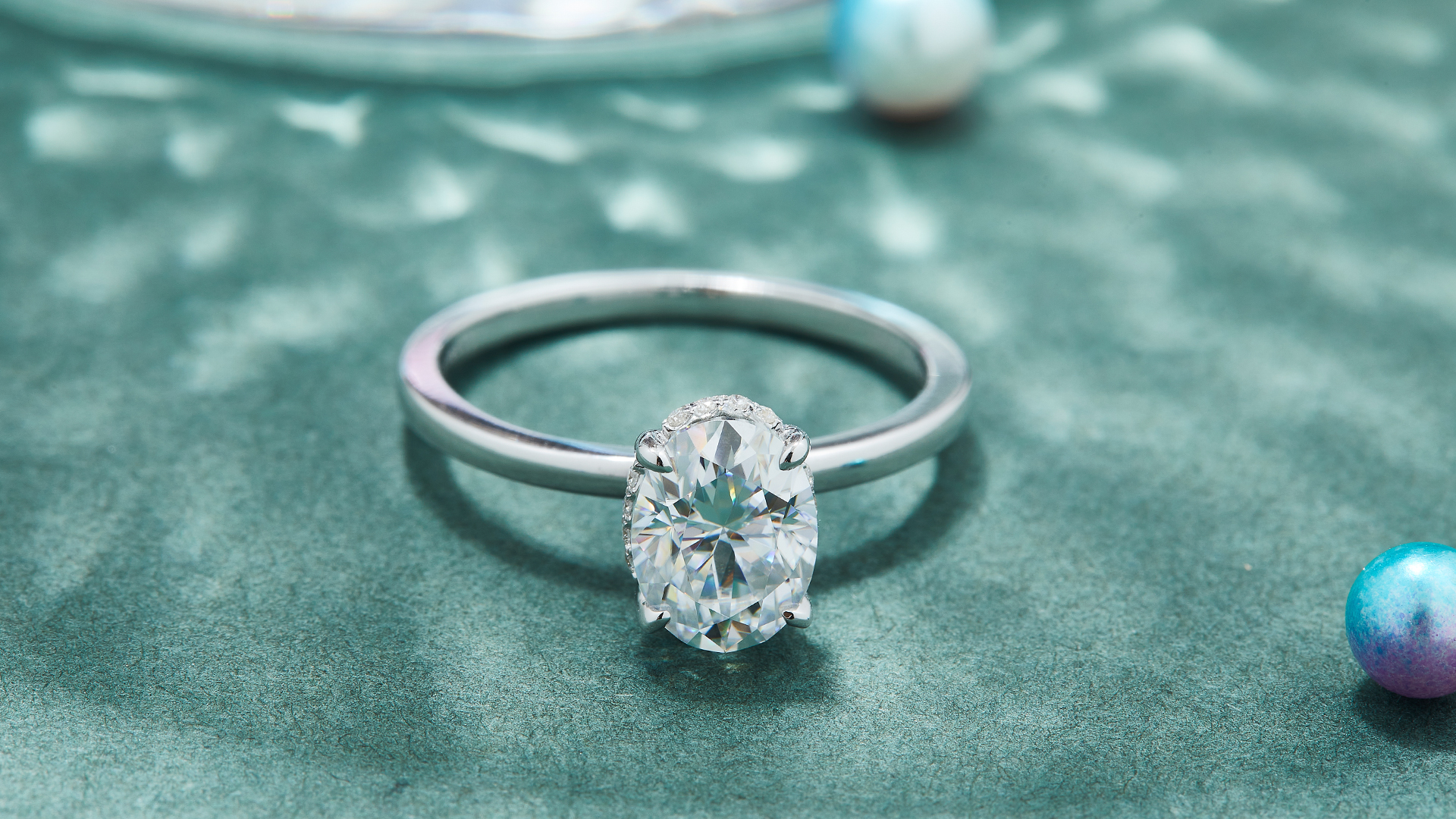
A sample should do more than demonstrate that the supplier can manufacture one piece. Its more important purpose is to establish exactly what the buyer has approved. For custom lab-grown diamond jewelry, an approved sample may define the center-stone specification, physical dimensions, metal, surface finish, ring size or chain length, setting structure, logo position, engraving and packaging. When CAD is involved, the production version should also be clearly identified.
7.1 Why an Approved Sample Matters for Reorders
Once approved, the sample can become a practical reference for bulk production and later reorders. It may be referred to as an Approved Sample, Master Sample or Golden Sample, but the terminology matters less than the function. Without an agreed reference, a buyer may later say that a new batch “does not look like the previous one,” while the supplier may believe it still meets the original description.
A physical reference combined with a written specification gives both parties a much clearer basis for comparison. For MOSUP custom projects, sample cost, development scope, revisions and later production conditions should be confirmed according to the specific design, metal, stone and manufacturing process.
8. Freeze the Production Version Before Bulk Manufacturing
An approved sample should not automatically move into bulk production without a final specification check. Custom projects often change during development. A buyer may approve one ring and later request a thinner band. A center stone may change from 1.5 ct to 2 ct. The metal may move from sterling silver to 14K gold. Packaging or logo requirements may be added after the initial sample. Each change affects what production and QC teams are expected to deliver.
8.1 What Should Be Confirmed Before Production Starts?
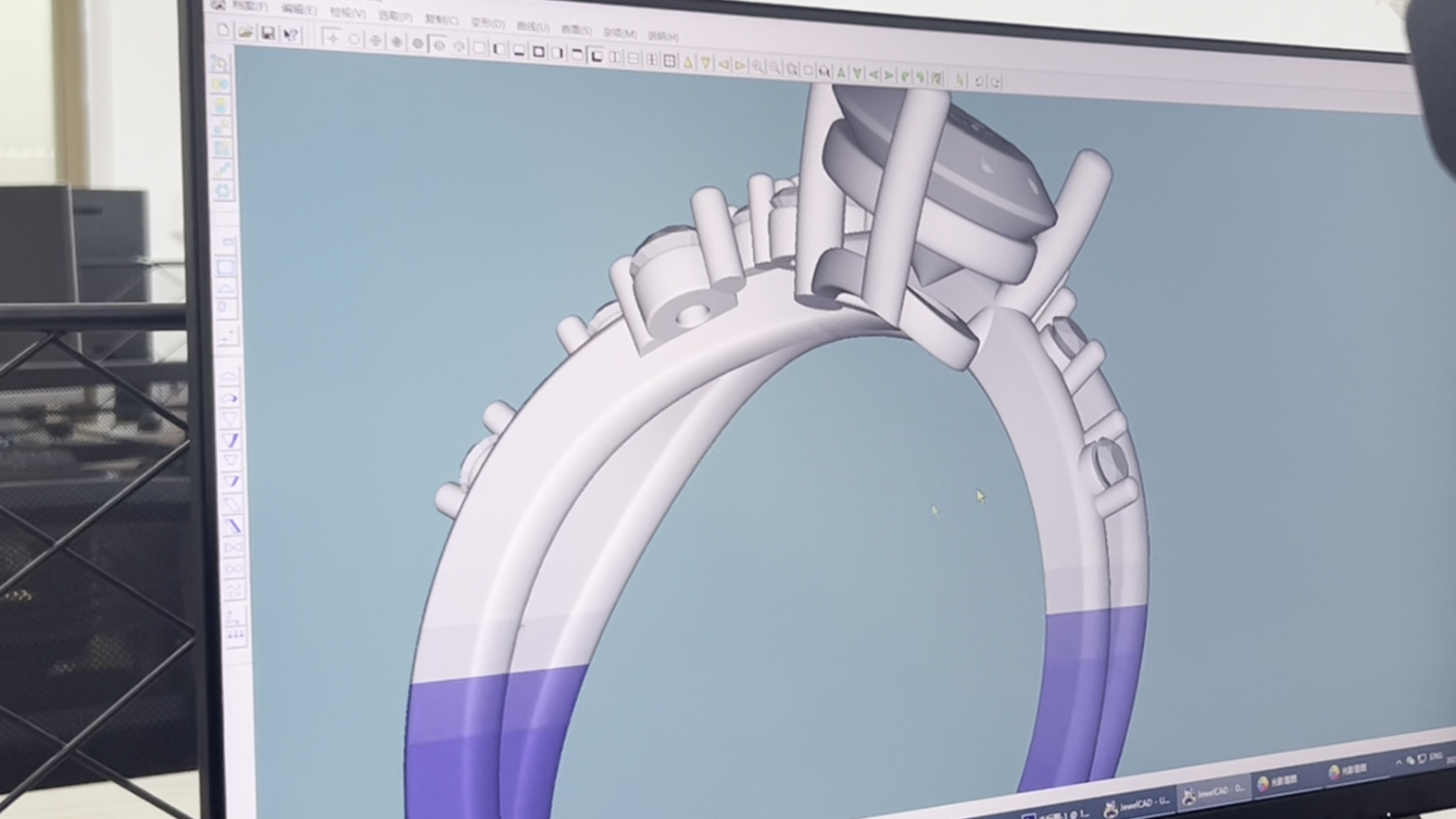
Before bulk manufacturing, the final record should identify the latest CAD or design version, approved sample, diamond specification, metal, finish, size, engraving, packaging, report requirements and production quantity. Informal changes that remain only inside email or WhatsApp conversations can create avoidable errors if they are not reflected in the final production specification. A professional order should therefore answer one question clearly: Which exact version are we producing?
9. Inspect the Complete Jewelry Product, Not Just the Diamond
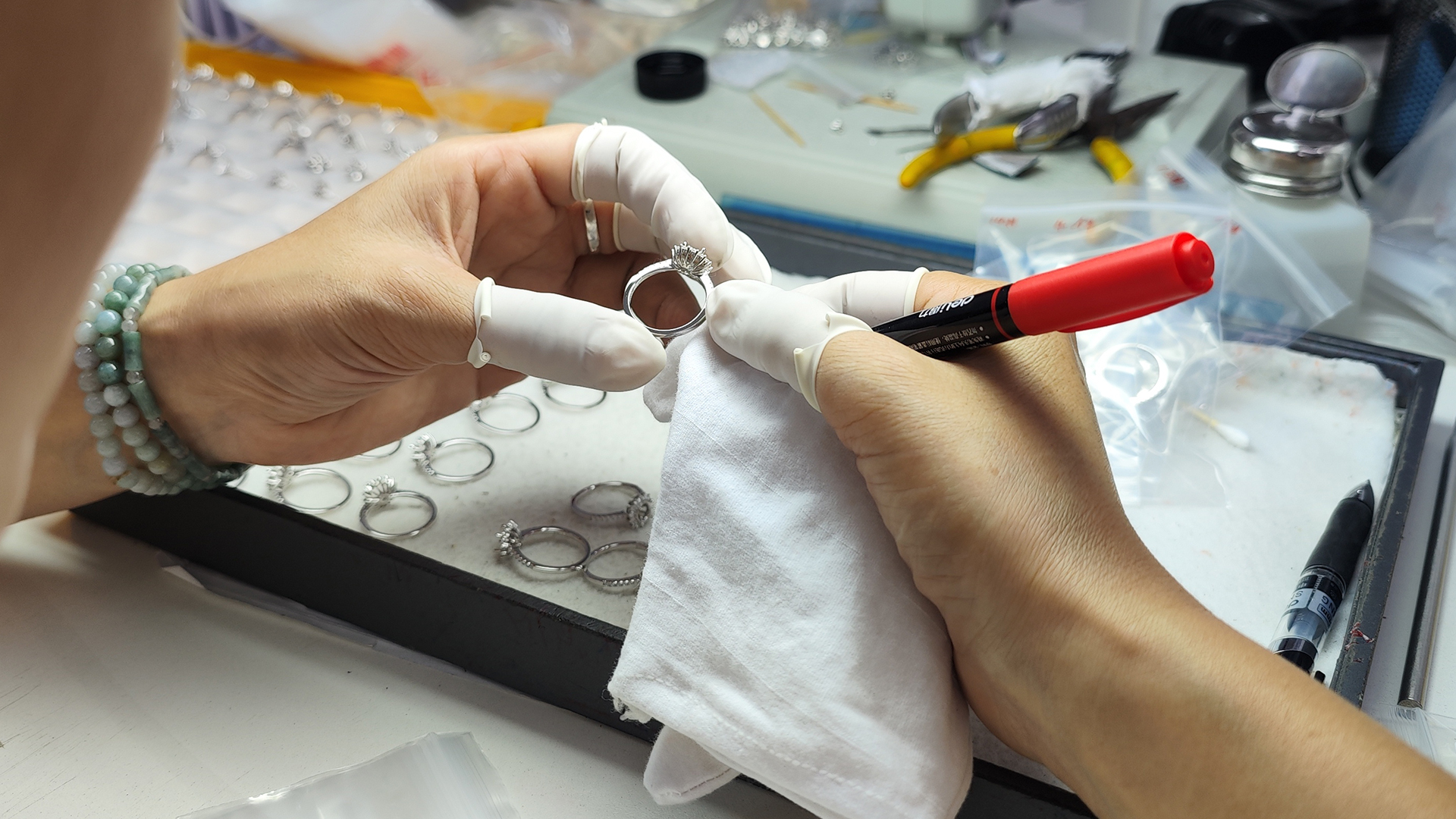
Lab-grown diamond jewelry QC should evaluate the finished product as a whole. A diamond report may confirm information about the center stone, but it does not confirm that the setting, metal, sizing, function and packaging have been produced correctly.
| Area | What the Buyer Should Confirm | Why It Matters |
|---|---|---|
| Diamond | Agreed identity, shape, carat/dimensions and visible condition | Keeps the stone specification consistent |
| Setting | Stone security, prongs, alignment and symmetry | Reduces loose-stone and workmanship issues |
| Metal | Correct alloy and finish | Confirms material specification and positioning |
| Surface | Polish, plating or finish, scratches and visible defects | Affects retail presentation |
| Dimensions | Ring size, chain length and relevant proportions | Reduces avoidable returns |
| Function | Clasps, posts, hinges and moving components | Confirms usability |
| Reports | Correct documentation where required | Maintains traceability |
| Branding | Logo, engraving and tags | Protects private-label consistency |
| Packaging | Correct packaging and protection | Completes the retail-ready product |
Why Reports Cannot Replace Finished-Jewelry QC
A grading report describes the diamond. Finished-jewelry QC evaluates the product the retailer will actually sell. That distinction is especially important for custom production, where the commercial product includes not only the stone but also the setting, metal, sizing, surface finish, branding and packaging. MOSUP's quality process should therefore be understood as part of the full product-development workflow rather than as a check performed only on the gemstone.
10. Compare Suppliers by Scope Before Comparing Unit Price
Supplier comparison should begin with the scope of the quotation. If Supplier A offers a lower unit price but uses a different diamond specification, metal, report requirement, packaging scope or inspection standard than Supplier B, the two quotations are not directly comparable. A professional supplier comparison should consider specification clarity, sample capability, documentation, communication, QC, production repeatability, lead-time transparency, customization capability, after-sales handling and support for future reorders.
10.1 What Should Be Included in a Comparable Quote?
The quotation should make clear whether the specified center stone is included, whether an IGI report is required or included, whether CAD or sample development carries an additional cost, whether logo engraving and custom packaging are included, and whether freight, duties or other logistics costs are quoted separately. The buyer should also understand what happens if the finished product does not meet the agreed specification. These details often reveal more about the actual commercial offer than the headline unit price.
The principle is simple: A low unit price without a clear scope is not a complete quotation.
11. Build a Clear RFQ Before Asking for the “Best Price”
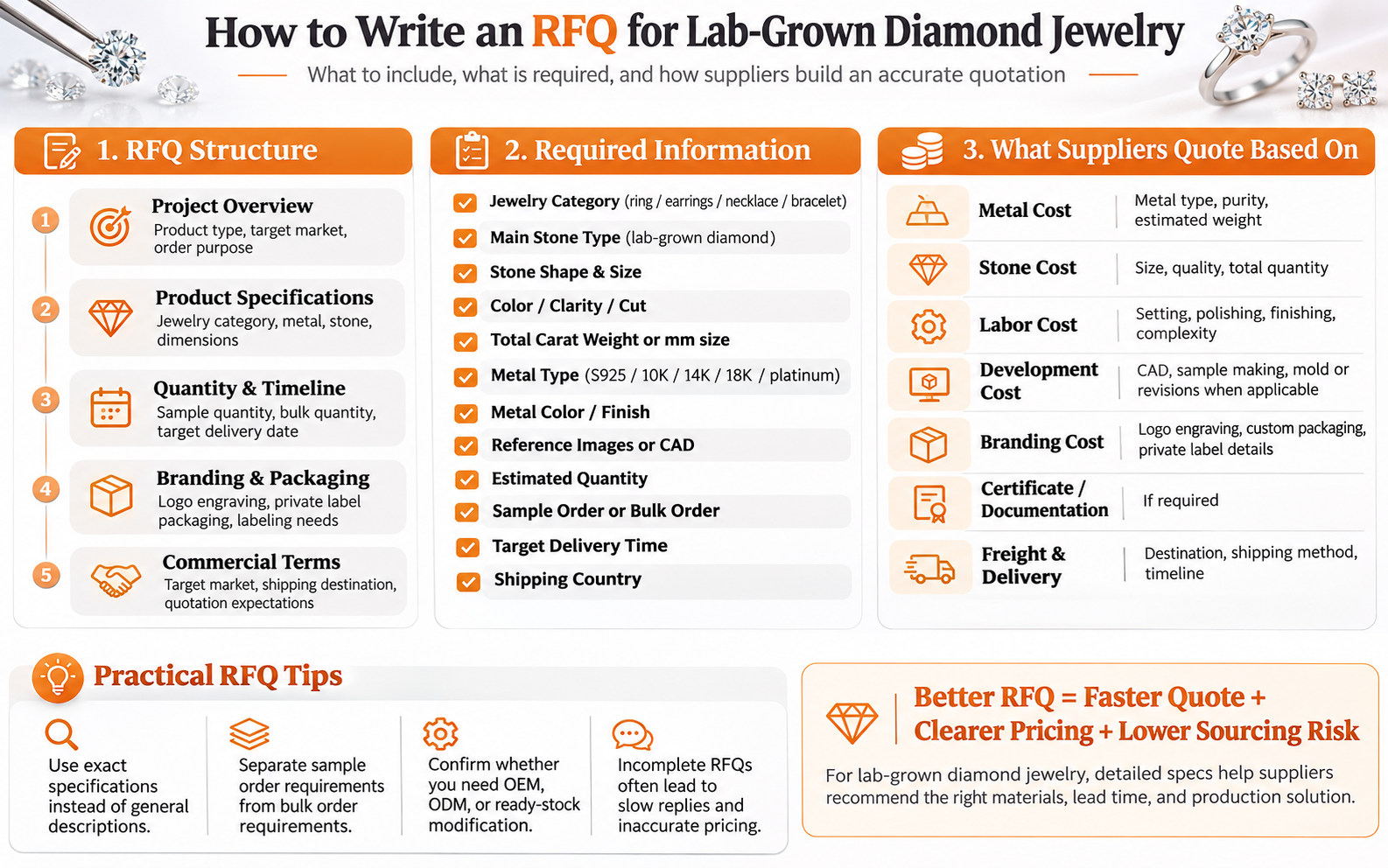
A useful RFQ does not need to be complicated. It simply needs to make the product identifiable. A professional buyer can use the following structure:
Product: Ring / Earrings / Necklace / Bracelet
Reference: SKU / Image / Sketch / CAD / Existing Sample
Gemstone: Laboratory-Grown Diamond
Shape: Round / Oval / Emerald / Pear / Cushion / Other
Center Stone: Carat Weight and/or Physical Dimensions
Color: Required Range
Clarity: Required Range
Cut / Finish: Required Specification Where Applicable
Report: IGI or Other Documentation Requirement
Metal: S925 / 10K / 14K / 18K / Platinum
Metal Color / Finish: White / Yellow / Rose / Other
Size: Ring Size / Chain Length / Relevant Dimensions
Quantity: Sample Quantity + Expected Production Quantity
Branding: Logo / Engraving / Hallmark / Tags
Packaging: Standard or Custom Packaging
Destination: Country and Delivery Location
Commercial Target: Target Retail Level or Purchasing Budget Where Useful
The clearer this information is, the easier it becomes to compare quotations on an equivalent basis. It also reduces unnecessary communication between purchasing, sales, design and production teams.
12. How MOSUP Supports Lab-Grown Diamond Jewelry Sourcing and Custom Development
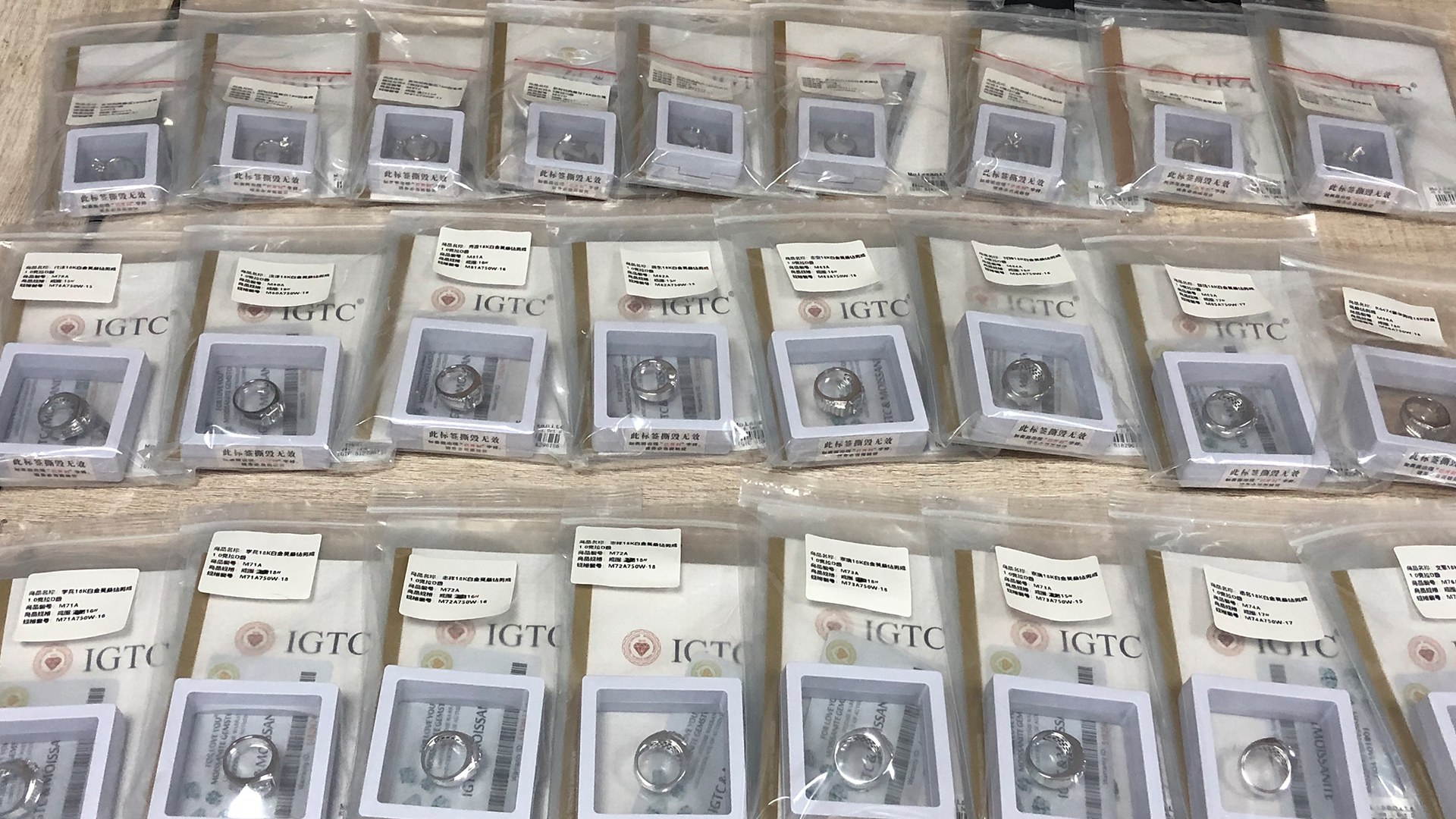
MOSUP works with jewelry brands, retailers, wholesalers and ecommerce businesses across both ready-stock sourcing and custom development. Buyers who are still testing the market can begin with existing lab-grown diamond jewelry to evaluate stone shapes, product categories and price points before committing to deeper inventory. Brands with proven demand can move into ODM by modifying an existing design, changing elements such as gemstone specifications, metal, structure, finish or branding. Businesses with their own sketches, reference images, CAD files or physical samples can move into OEM development when they are ready to build a more proprietary collection.
12.1 From Product Testing to OEM/ODM Development
For custom projects, MOSUP can coordinate jewelry development, manufacturing, quality control and fulfillment across its supply chain. Project-specific diamond grades, reports, quantities, sample terms, production timing, packaging and pricing should always be confirmed in the quotation rather than assumed from general website information.
If you already have a product reference, diamond specification, metal, quantity and destination market, the MOSUP custom jewelry service can be used to discuss development options. If the project specification is already clear, buyers can contact MOSUP with the product reference, stone requirements, material, quantity, branding and packaging requirements to request a project-specific quotation.
13. Frequently Asked Questions
13.1 Is CVD or HPHT Better for Wholesale Lab-Grown Diamond Jewelry?
Neither growth method is automatically better. CVD and HPHT describe how the diamond was produced, not the complete quality of the finished stone. Wholesale buyers should still evaluate carat, dimensions, color, clarity, cut, appearance, report requirements, availability and price.
13.2 Does Every Lab-Grown Diamond Need an IGI Report?
No. Report requirements depend on the product, stone and commercial positioning. If an IGI report is important, the buyer should confirm it before quotation and define how the report should correspond to the physical stone or jewelry item.
13.3 Can I Order One Sample Before Bulk Production?
Sample development can be discussed before larger production. The exact sample cost, development scope, timing and later bulk-production conditions should be confirmed according to the specific design, material and process.
13.4 Is There an MOQ for Lab-Grown Diamond Jewelry?
Ready-stock and custom production should be treated separately. MOSUP's ready-stock wholesale business can support low-quantity purchasing, while custom production quantities depend on the design, metal, diamond specification and manufacturing process.
13.5 Should a Startup Brand Choose S925 or 14K Gold?
It depends on the product and target customer. Sterling silver can help reduce initial inventory exposure for selected market tests, while 14K gold may be more appropriate for bridal or higher-positioned fine jewelry. The decision should be based on retail price, margin, customer expectations and brand positioning.
13.6 Can MOSUP Modify an Existing Jewelry Design?
Yes. Depending on the project, buyers can discuss changes to gemstone, metal, structure, finish, engraving and branding, or provide sketches, photos, CAD files and physical samples for further development.
13.7 What Information Is Needed for an Accurate Quotation?
At minimum, provide a product or reference design, lab-grown diamond specification, metal, quantity and destination. For custom projects, sizing, branding, packaging and report requirements should also be included where relevant.
13.8 What Should Be Checked Before a Bulk Order Ships?
The final QC should compare the finished jewelry with the approved order or sample, including the diamond specification, setting security, metal, surface finish, dimensions, function, reports, branding and packaging.
14. Final Takeaway: Define the Product Before Comparing the Price
Professional lab-grown diamond sourcing begins before a supplier sends a quotation. The buyer first needs to define what the product is, who it is for and how the finished product will be approved. Once those points are clear, CVD and HPHT become technical characteristics rather than shortcuts for quality. The 4Cs become commercial specifications instead of a race toward the highest grade. IGI reports become documentation rather than substitutes for QC, and samples become production references rather than one-time prototypes.
A mature sourcing process therefore connects: Specification → Sample → Approval → Production → QC → Reorder
Brands that are still testing demand can begin with available products and reduce the amount of capital committed before the market is understood. Once the strongest designs and price points become clear, ODM and OEM can create more differentiation without forcing the brand to guess at demand from the beginning. And when a project is ready for quotation, the most useful first step is not simply asking a supplier for the “best price.” It is providing a clear product specification that both buyer and supplier can understand, quote, manufacture and inspect.


