
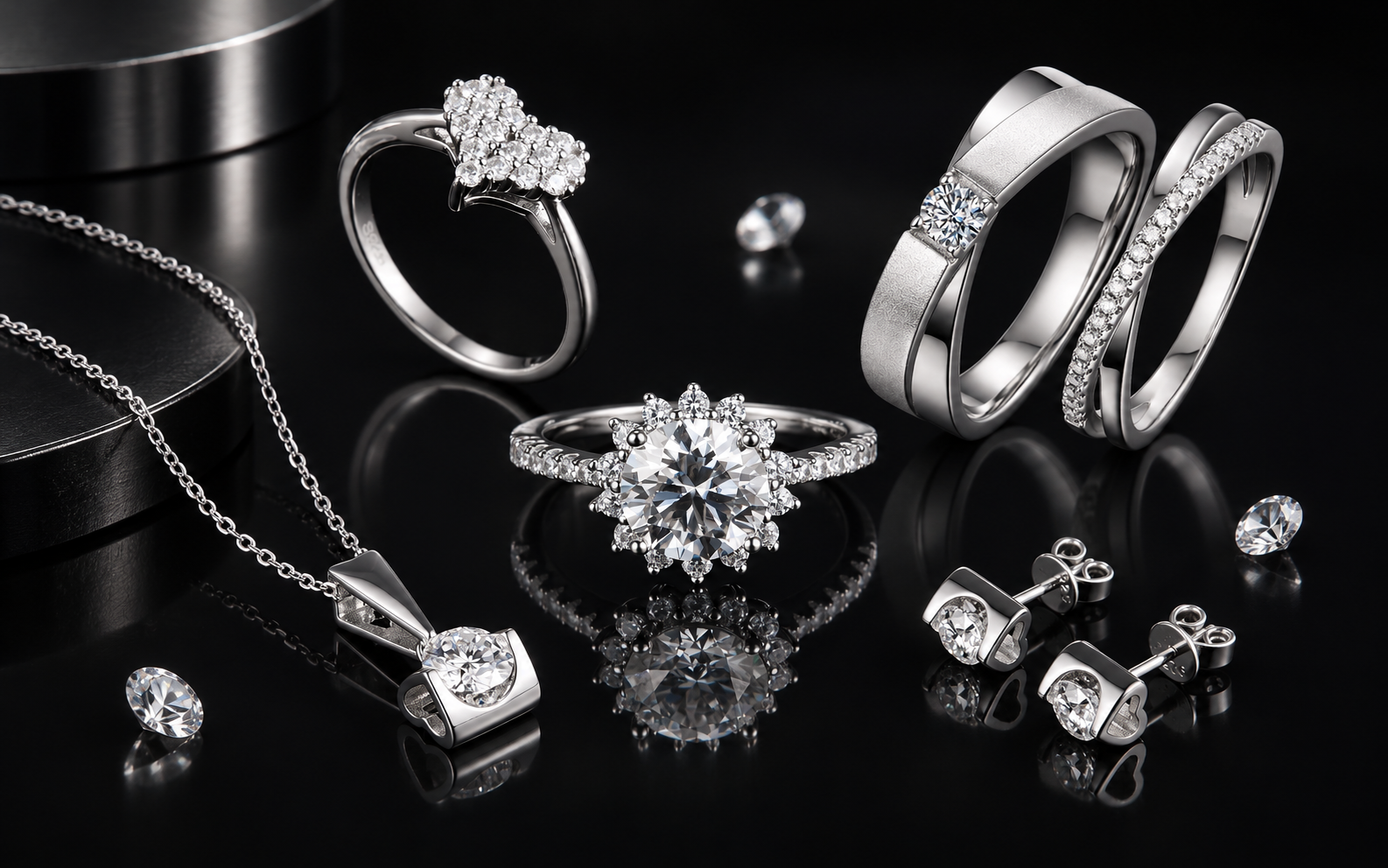
For jewelry brands, ready stock and custom production are not mutually exclusive sourcing models. In practice, the strongest purchasing strategy is often to use different models at different stages of business growth.
When a brand is still learning which stone shapes, product categories or price points customers prefer, ready-stock jewelry offers a faster and lower-risk way to collect real sales data. Once certain products have been validated by the market, ODM can help create stronger differentiation. OEM becomes more valuable later, when the brand has a clearer design language, a more stable customer base and enough market evidence to justify deeper product development.
This is also why many jewelry retailers do not begin by building an entirely original collection. Private-label development often starts with existing products, light modifications and branding before moving into exclusive designs. The commercial issue is simple: differentiation cannot solve an inventory problem if the underlying product has not yet been proven. For buyers, the real question is therefore not, “Is ready stock or custom manufacturing more professional?” A more useful question is: “Does my brand currently need to learn the market faster, or does it need stronger product differentiation?”
1. Ready Stock and Custom Production Solve Different Business Problems
The biggest unknown for a new jewelry brand is usually not whether a supplier can manufacture the product. It is whether customers will actually buy it. Trend reports, social media and competitor research can help identify possible directions, but they cannot fully replace real sales data. Will oval center stones outperform round? Should the first assortment focus on rings or earrings? Which price point converts more consistently? Do customers care more about center-stone size or about the design itself? Without actual orders, these decisions are still assumptions.
Ready stock reduces the cost of finding the answers. Custom production solves a different problem. Once a product begins generating stable demand, a brand may realize that continuing to sell designs that look very similar to products available from other retailers makes it difficult to build long-term brand value. At that stage, customization becomes less about simply “making something different” and more about turning proven demand into a more recognizable product. The three models can therefore be understood in a simple way: Ready Stock is for learning the market. ODM is for improving what the market has already accepted. OEM is for building products the brand can truly call its own.
2. For New Brands, the Biggest Advantage of Ready Stock Is Lower Learning Cost
Ready stock is often described as cheaper and faster, but for a new jewelry brand, its more important advantage is that it reduces the cost of making the wrong decision. Imagine a brand preparing to launch its first lab-grown diamond collection. If it develops ten original 14K gold designs immediately, it may need to invest in design work, CAD, samples, production and higher-value inventory before any of those products have generated real sales. If only two of those ten designs become consistent sellers, the remaining inventory effectively becomes the cost of an incorrect forecast.
A more flexible approach allows the brand to test several product directions before committing heavily to any one of them. That test can answer practical questions such as which diamond shapes convert more consistently, which categories are easier to sell, which retail prices perform best, whether customers respond more strongly to larger center stones or design details, and which products generate repeat orders. Once these patterns become visible, custom development has a much stronger foundation. MOSUP currently offers more than 4,000 ready-stock jewelry styles and supports low-MOQ purchasing, allowing brands in the testing stage to build a lighter initial assortment without paying full development costs for every SKU.
——MOSUP Lab-Grown Diamond Jewelry Collection
3. When Should a Brand Move From Ready Stock to ODM?
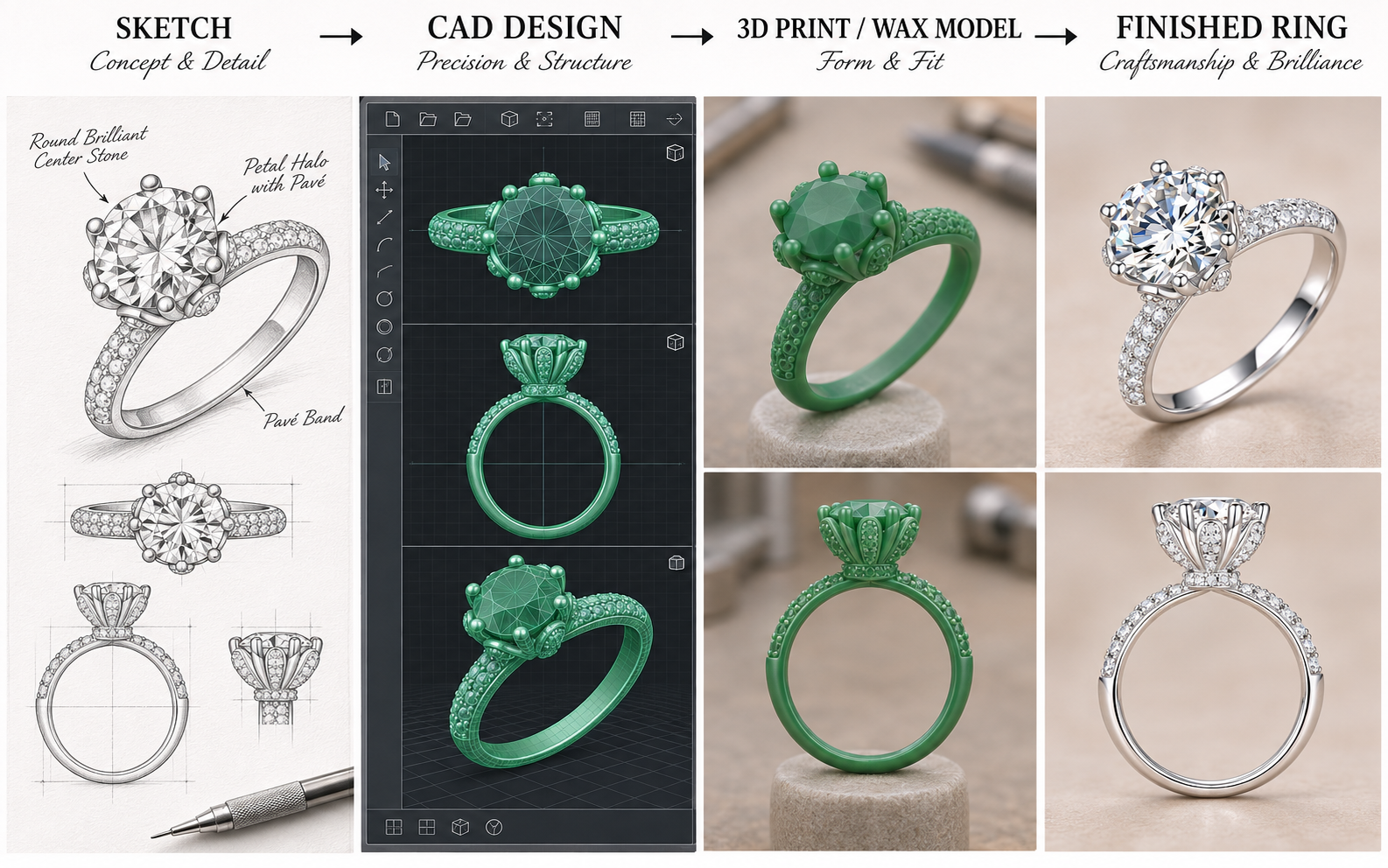
A brand usually does not need to redesign a successful ready-stock product from scratch. The more common situation is: “Customers like this product, but we want it to feel more like our brand.” That is where ODM becomes useful. The basic product logic has already been validated, so the brand can focus on changing the elements that matter most. These may include the center-stone shape, carat weight, metal, shank profile, surface finish, logo, engraving or packaging. This is more practical than beginning again from zero because the brand is not guessing at demand. It is improving a product that has already demonstrated commercial potential. For a growing brand, ODM is often the most important step between ready stock and full OEM development.
A sterling-silver round lab-grown diamond ring, for example, may already have consistent sales. Instead of replacing it completely, the brand could test an oval version, develop a 14K version or add branded engraving and packaging. Each modification is based on previous customer feedback rather than another untested assumption.
——Custom Lab-Grown Diamond Jewelry Development
4. The Real Value of OEM Is Long-Term Product Ownership
OEM is generally most valuable for brands that already have a clearer sense of what they want to become. By this stage, the brand may understand its strongest customer segment, core price range, preferred stone shapes and the design details that should remain consistent across future collections. That is when original development begins to create strategic value. OEM is not only about making a product that looks different from competitors. It allows a brand to build its own system of proportions, dimensions, stone preferences, setting styles, materials, finishes and packaging standards. Over time, those details become product assets.
A brand may begin with an existing supplier assortment, add a logo, modify selected details, develop private-label versions and eventually move into exclusive designs. That progression is often more sustainable than trying to create a completely original collection from the first season. Starting OEM later does not necessarily mean moving more slowly. If the development is based on real sales data, the brand is more likely to create products worth keeping in the assortment for years.
5. Ready Stock, ODM and OEM Represent Different Levels of Commercial Commitment
From a sourcing perspective, the main difference between these models is the amount of capital, development work and certainty a brand is willing to commit. A brand does not need to remain in any one model permanently. A stronger approach is to increase customization as market certainty increases. For many jewelry businesses, the most effective path is therefore not “Ready Stock or Custom,” but “Ready Stock → ODM → OEM.”
6. MOQ and Samples Determine Whether Testing Is Truly Low Risk
The value of a sourcing model depends heavily on its MOQ and sample policy. If a so-called test order still requires hundreds of pieces, the buyer has not actually reduced much risk. For a new brand, the more useful sequence is to inspect the product first, approve the design, place a smaller commercial order and then decide whether to scale based on actual sales. This makes the sample an important risk-management tool rather than an unnecessary extra step.
MOSUP currently supports no MOQ for ready-stock products. For custom projects, a starting quantity of around 10 pieces is commonly recommended, depending on design, material and manufacturing requirements, while one-piece samples can be produced for suitable projects. That allows the sourcing process to follow a more natural sequence: Sample → Small Order → Reorder → Scale. The sample confirms the product. The first commercial order tests the market. The reorder is the first real evidence that the product deserves more investment.
——Sample Orders Before Bulk Production
7. Ready Stock and Custom Production Should Also Be Considered Together With Metal Strategy
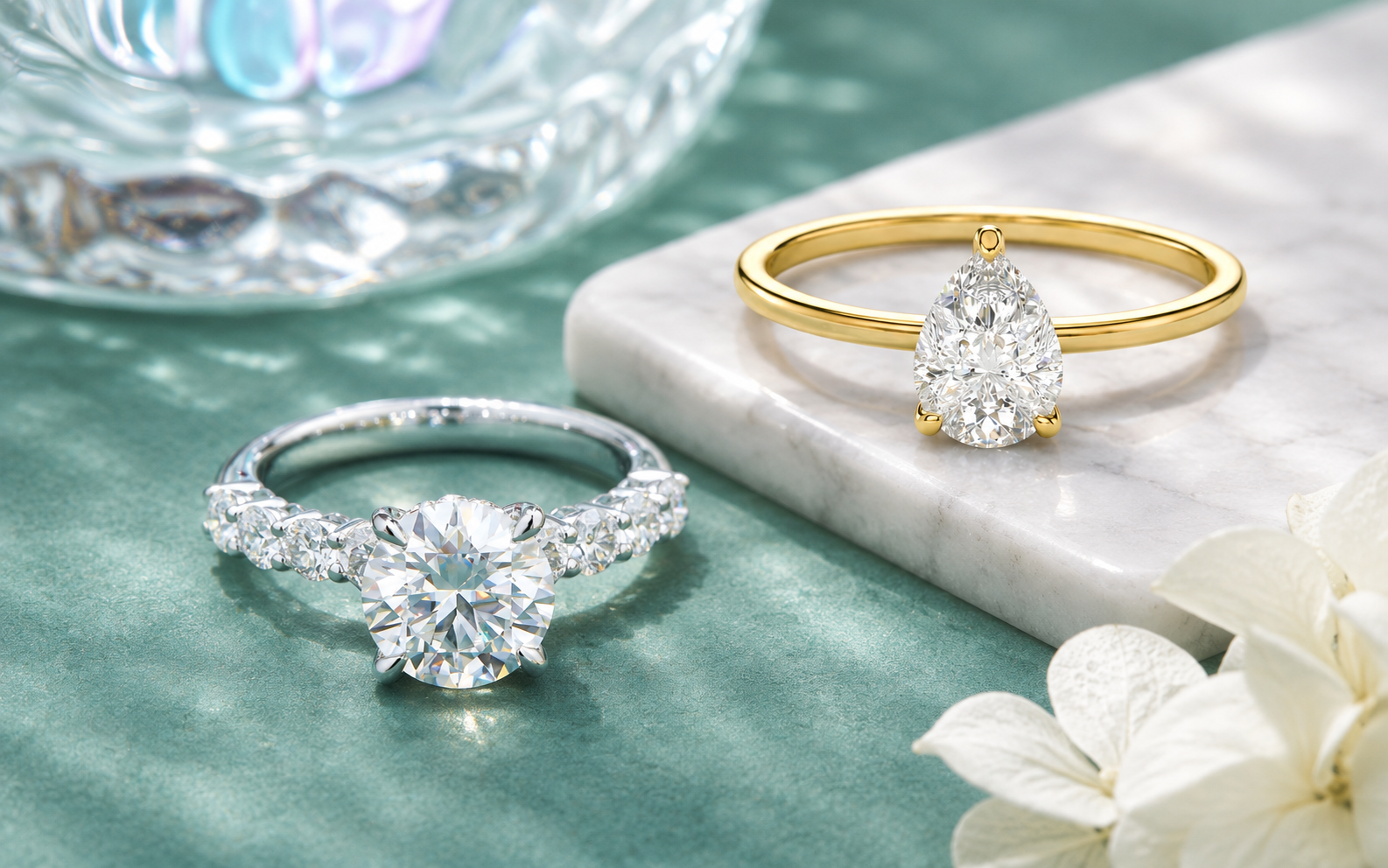
Sourcing model and metal choice are closely connected. A new brand that develops a large number of untested SKUs in 14K or 18K gold may tie up a significant amount of capital before demand is clear. By comparison, selected S925 lab-grown diamond products can be used to test market response with lower initial exposure. Once a design begins generating stable sales, the brand can consider developing a K-gold version.
This is why metal upgrades can evolve together with customization depth. A practical product path might look like: S925 Ready Stock → S925 ODM → 14K Sample → 14K ODM → OEM Collection. This is not simply a move from a cheaper material to a more expensive one. It is a gradual increase in product investment as market certainty improves.
——S925 vs 14K Gold for Lab-Grown Diamond Jewelry
8. A More Mature Sourcing Strategy Makes Each Step Depend on the Previous One
For most growing jewelry brands, a staged approach is more practical: Ready Stock → Test → Reorder → ODM → OEM.
The purpose of the first stage is not to create the most unique product possible. It is to understand the customer quickly. The second stage uses reorders to confirm that the first sales were not accidental. The third stage introduces ODM to build differentiation around products that have already been validated. The fourth stage uses OEM to create a longer-term proprietary collection. The advantage is that every new investment is based on information collected in the previous stage. The brand is not simply guessing. It is using real orders to reduce uncertainty over time.
This approach is also consistent with the commercial logic behind made-to-order jewelry: reducing unnecessary inventory exposure and avoiding large production commitments before demand has been proven. For many jewelry brands, this is more sustainable than trying to build a complete original collection in the first season.
——Wholesale Lab-Grown Diamond Jewelry Sourcing Guide
9. How MOSUP Supports Brands From Ready-Stock Testing to OEM Development
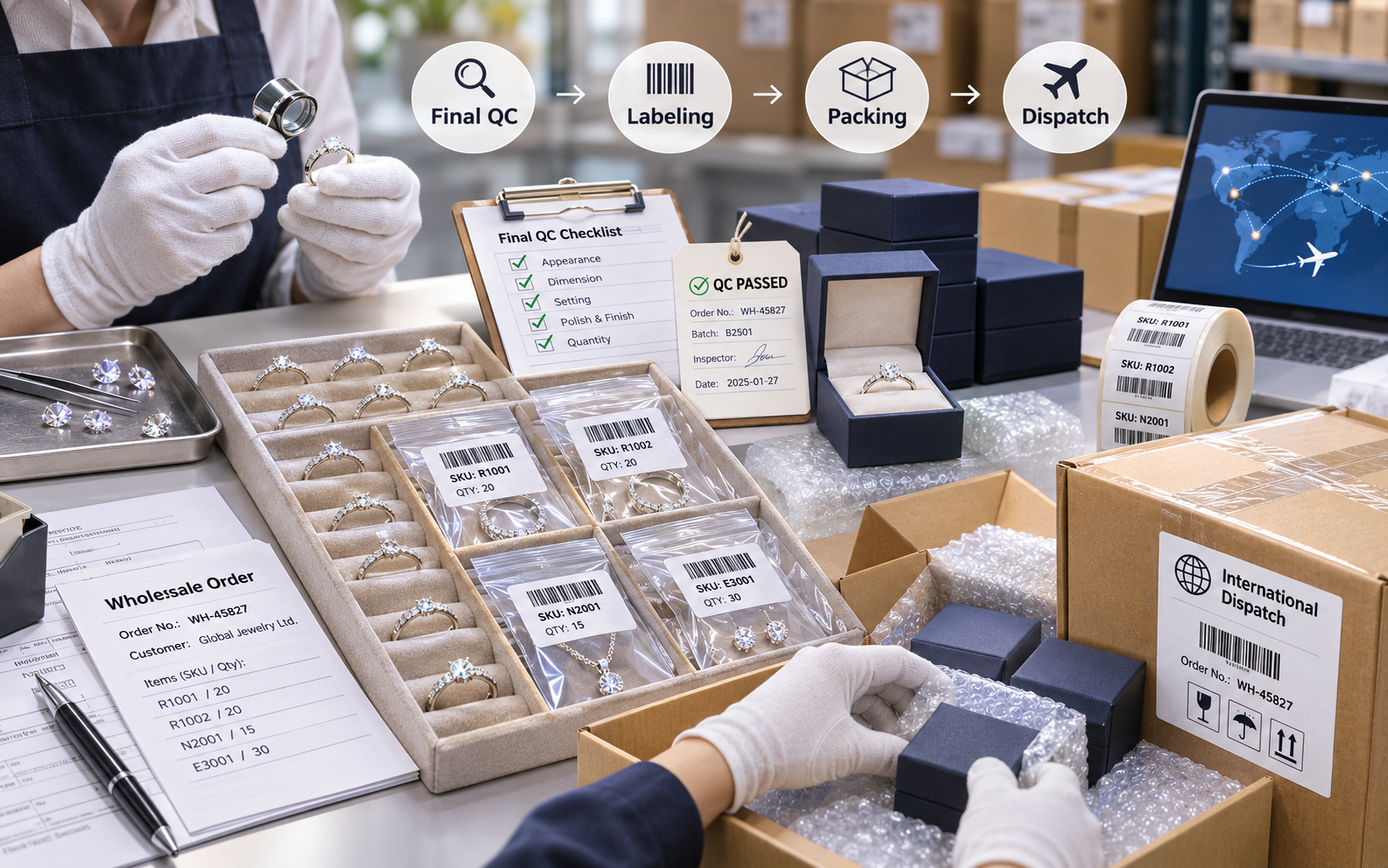
MOSUP's sourcing model is designed to support brands at different stages of development. Early-stage buyers can begin with ready-stock lab-grown diamond rings, earrings, necklaces and other categories to test product direction with a lower purchasing threshold. MOSUP currently offers more than 4,000 ready-stock styles and supports low-MOQ sourcing for faster market testing. Once a brand identifies products with stable demand, it can move into ODM. MOSUP supports modifications to center stones, materials, dimensions, structure, logo and packaging, allowing successful products to become more aligned with the brand's identity.
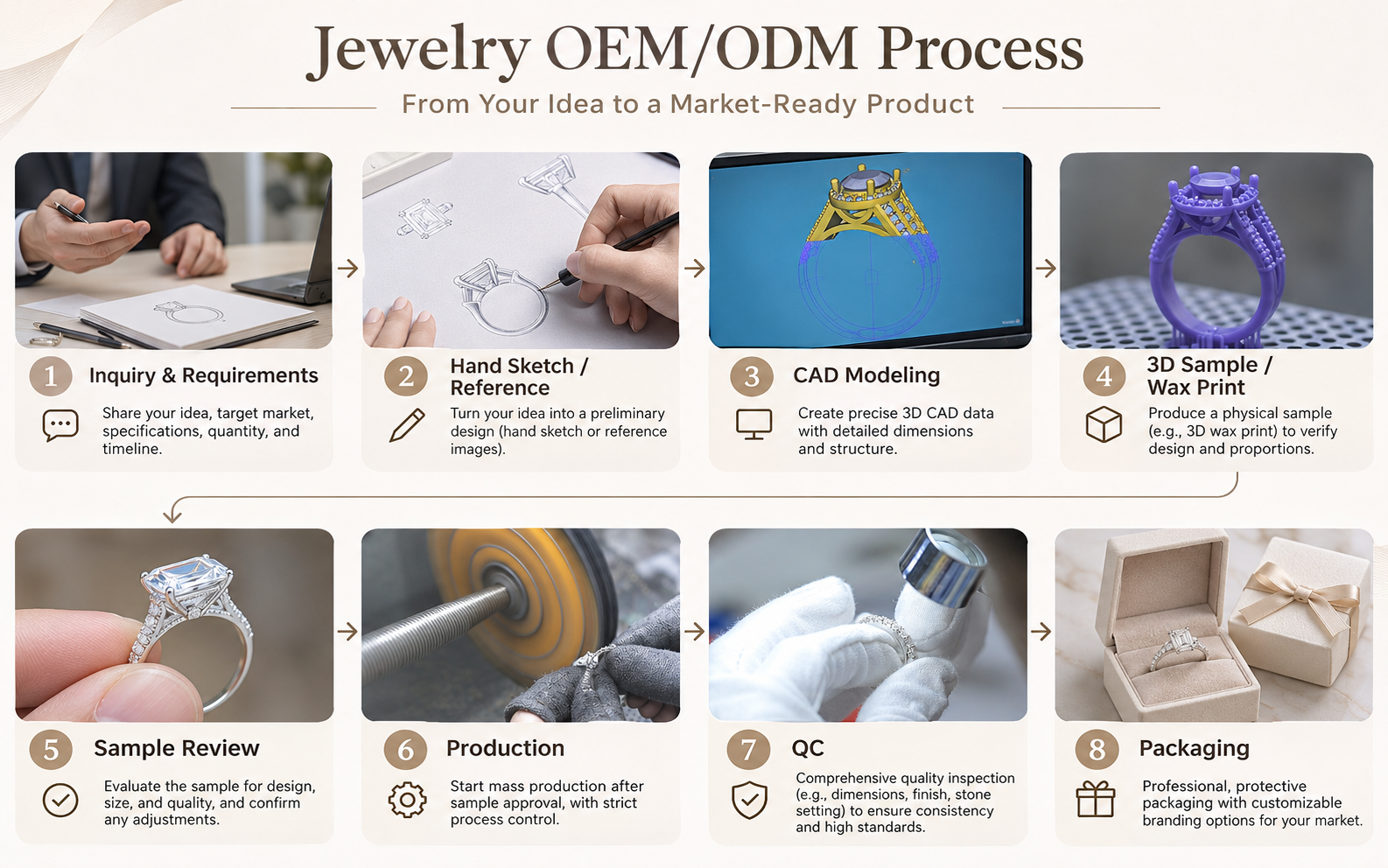
Brands with original designs, reference images, CAD files or physical samples can move into deeper OEM development. MOSUP supports CAD/ZB/Rhino modeling, 3D printing, sample development, hand stone setting, polishing, plating, logo engraving, private-label services and custom packaging, with quality checks before bulk production and shipment.
For brands, this means sourcing does not need to be treated as a one-time decision. It can develop progressively: Ready-Stock Testing → Sample → Small Order → Reorder → ODM → OEM → Bulk Production. Ultimately, ready stock and custom production answer two different questions. Ready stock answers: “How can we learn what the market wants faster?” Custom production answers: “Once we know what the market wants, how do we turn that demand into a product that is more recognizably ours?” A mature jewelry brand will often need both. The difference is simply when to use each one.


